• About
  • Blog Posts
  • Front Page
  • Greatest Hits

Apologetics4all – Dr. Williams' Religion Blog

~ Respectfully giving reasons for faith – 1 Peter 3:15

Apologetics4all – Dr. Williams' Religion Blog

Author Archives: D. L. Williams

Healing words for a sick world

01 Friday Dec 2017

Posted by D. L. Williams in Campus Apologetics, Sexual Ethics

≈ Leave a comment

Sick of hearing about the sexual [mis]conduct of nearly every famous news anchor, politician, coach, actor, producer, etc?

Me too.

Rather than rant about it, why not step back and analyze it some? Here is an excellent article from Salvo Magazine on loving relationships. -DW

(Hat-tip to Wintery Knight.)

–Begin Excerpt–

Mastering Modern Love

How Chastity Orders Your Relationships & Liberates You for Love, by Terrell Clemmons

Chastity: So Out, It’s In

The second approach is one Dawn developed following her Christian conversion, when she completely rethought how to “do” unmarried life. This approach offers modern singles like Jordana something they desperately need but may not even know exists: a sound alternative paradigm for love and sex—a lifestyle she calls singular. “To be singular is to understand the meaning of chastity, and chastity by its very nature goes against the popular culture’s beliefs regarding sex and choice.” It’s “the new counterculture . . . so out, it’s in.”

Contrary to the pervasive bad press it’s gotten from libertines, chastity isn’t about “not having sex.” In fact, it’s about a lot more than just sex. Dawn defines it beautifully: “Chastity is the virtue that enables us to love fully and completely in every relationship, in the manner that is appropriate to the relationship.” Of course, this raises the question of what determines appropriateness, but from both a scriptural and natural law standpoint, this is an easy question to answer. Sexual expression is appropriate to the marriage relationship and inappropriate to all others. Whether or not it’s easy to follow is certainly another matter, and Dawn gives excellent counsel on that and other related matters, but the point here is that the categories are discrete and clearly discernible.

The Chaste Singular

More important, chaste living is grounded in something larger and more permanent than the individual. Whereas in modern singlehood, love is based on feelings, which are apt to change with the wind or even last night’s dinner, chaste love is defined by and grounded in God himself. Love of God—love for God and love from God—becomes the love that orders all other loves. “For each of those whom divine providence places in your life,” Dawn writes, “friends, family, the stranger on the street—you ask yourself, how can I love God through loving this person?”

Whereas the modern single is driven by an inner void that is desperately trying to get filled, the chaste singular looks to God himself to fill the void. Rather than trying to get love through the right match, the chaste singular receives love from God, the ultimate source, and then turns outward with love to give from an inner fullness.

Chaste love is respectful. It behaves with appropriate decorum, which requires forethought. What is the nature of this relationship? Why am I in it? Where is it headed? What are my intentions?

—Read the whole article—

On The Unreasonableness & Inconsistency of Atheism

29 Wednesday Nov 2017

Posted by D. L. Williams in Uncategorized

≈ Leave a comment

Worth a look, especially because of the long quote of Richard Howe. I have enjoyed Richard’s talks every time I have seen one. He is an excellent teacher of philosophy. He is also VERY generous with his material. See the resources tab on his website: http://www.richardghowe.com/

How does church appear to someone raised in a non-Christian home?

28 Tuesday Nov 2017

Posted by D. L. Williams in Uncategorized

≈ Leave a comment

A tough read for some Pastors, I’m sure. This is shared in love and with a plea to take it to heart for the most important generation (the NEXT generation).
Students (and faculty and everyone else) need reasons. We need much more “Paul in Athens” in our churches. But notice, Paul was familiar with the Greek poets in addition to the Scripture. He was widely read and he interacted with the world in addition to the Synagogue. -DW

Scientist, Neil Shenvi, on the Three Major Paradoxes of Atheism

20 Monday Nov 2017

Posted by D. L. Williams in Uncategorized

≈ 1 Comment

A good distillation of 3 paradoxes that emerge from a materialist perspective.

Welcome SHSU SSA Members

16 Thursday Nov 2017

Posted by D. L. Williams in Campus Apologetics, Grief, Death, and Dying, Historiography, Philosophy, Ratio Christi, Reality Blog

≈ Leave a comment

ssa-logo

I was pleased to accept an invitation to address the SHSU Secular Student Alliance at their Nov 16th meeting.

For the students who I met there, I created this landing page for you in the event that you come to my blog seeking more information about my remarks.

Since I am a full-time Chemistry professor and not a full-time blogger, my posts are few and far between. And they are not a comprehensive treatment of the Christian religion. Still, I think they are useful and encouraging or I would not have written them.

I welcome your questions about anything I have written, preferably personally. Let’s have lunch at the South Paw. I’ll buy the first one. OK?

My main remarks were on What I believe and why I believe it.

I talked about Christianity being the best description of reality – the way things REALLY are. No doubt this is a curious claim.

I discussed evidence outside of Christianity that corroborates the main points in the life of Jesus.

You may have incorrect thoughts about what the word ‘faith’ means within a Biblical framework. This series of posts at the Ratio Christi at SHSU blog should help you understand that there is No Such Thing as Blind Faith.

If I had to predict what tomorrow’s questions will be, I’d choose the following:

  1. The Problem of Evil and Suffering. (Video 1 and Video 2)
  2. Moral Issues
  3. Science Issues (The Big Bang and Fine Tuning)
  4. Philosophical Questions (Contingency and Ontology)
  5. Biblical Questions (What is the Bible? The Story in the Bible. Literary Styles in the Bible. The Bible as Meditation Literature. and The Use of Narrative Passages in the Bible.)
  6. Specific Questions about Biblical Passages (Go to the Bible Project to see an OVERVIEW OF EVERY BOOK OF THE BIBLE. Their work is masterful!)

None of this will matter if you are unable to entertain the idea that you might be wrong in your assumptions. Yes, that cuts both ways. I’m okay with that.

Are you?

God bless you for making it this far.

-DW

Five Ways Historic Christianity Relates Faith to Reason

19 Tuesday Sep 2017

Posted by D. L. Williams in Uncategorized

≈ Leave a comment

An excellent post by Ken Samples. Read it carefully. He makes some interesting points that are sure to make you think.

Kenneth's avatarReflections

819619840

Many people view faith and reason as being at odds with one another. For example, some differentiate faith from reason by asserting that faith merely involves hoping something is true, whereas reason involves affirming something to be true based upon justifying evidence. According to this model, faith is equivalent to wishful thinking and is thus incompatible with reason. But historic Christianity’s view of faith and reason is very different from this popular stereotypical definition.

In defining the relationship between faith and reason, historic Christianity draws upon both Scripture and sustained logical analysis. Here are five ways that historic Christianity relates faith to reason:

1. Faith’s Definition Involves Reason

In a biblical context, having faith (Greek: the verb, pisteúō, “believe”; the noun, pístis, “faith”) means confident trust in a credible source (God, Christ, or the truth). So the root word for faith in the New Testament is…

View original post 382 more words

The Six R’s of Education

21 Monday Aug 2017

Posted by D. L. Williams in Education, Philosophy

≈ Leave a comment

what-to-study

Welcome to the start of the Fall 2017 School Year.

This post is for teachers AND students. I hope it encourages you to start the semester strong.

You have heard of the Three R’s of Education – Readin’, Ritin’, and Rithmatic.

But there are three other R’s that are a vital part of education. In fact, they hold the key to progress in the first three R’s.

They are Responsibility, Respect, and Reverence.

Responsibility

How many problems in education would be fixed immediately if all parties thought about THEIR particular responsibilities. The state, the school boards, the school administrators, the teachers, the students, and their parents (grandparents or guardians) all have responsibilities that cannot be eliminated. The other parties cannot fill the role of any missing member of this set of responsible parties.

Respect

Even when it is hard to give or seems unearned. Respect should be taught, and it should be modeled. Be the first to offer respect, especially when it is difficult to do so. There are many impressionable eyes watching your behavior. I’m speaking to the parent, the teacher, and also the student. Be the first to offer respect.

(Repetition is the mother of pedagogy.) Be the first to offer respect.

Reverence

This is the least obvious of the 6 R’s. But I think reverence is the master key that is missing in many schools.

I always associated reverence with holy places or churches. But actually, reverence is simply recognizing a place as being special.

School is a special place.

The Christian world view would agree with this concept. Education is a part of what we call Common Grace. It is a gift from God just like our fruitful planet and our rational minds.

What if we taught reverence for the actual school?

It was a different time and a different economic situation, but when I was in school, it made sense for a teacher to challenge me if I put my feet on the desk with the question, “Do you put your feet on the furniture at home?” The implication was “no”. And if I wouldn’t do it at home, then I shouldn’t do it at school. But this question doesn’t make any sense to many of our students.

Some of our students don’t have furniture or even homes.

New questions could be asked,

“Is that how you treat the place that is changing your life for the better?”

“Is that how you speak to a person who is pouring their heart and soul into your education?”

“Is that how you treat your fellow students, who are trying to better themselves just like you are?”

I say we raise the bar – not just to the first three R’s for state testing purposes, but to the 6R level – where students recognize their responsibilities, where they respect the dignity of those behind them, with them, and above them in the educational endeavor, and where they come to revere the facilities and persons who daily sacrifice on their behalf.

We raise the bar for the staff as well – where they seriously approach their responsibilities, where they will be the first to offer respect to each other, the students, and ‘the bosses’, and where they will also revere the facilities. Yes, even those broken down facilities that will not quit in the task of changing lives in Huntsville and beyond.

What a master key reverence can be. When combined with the other 5 R’s, we can do AMAZING THINGS at our schools.


Where do these thoughts come from? Well, when it comes to taking the initiative, we have no better example than God. 

8 But God proves his own love for us in that while we were still sinners, Christ died for us. [Romans 5:8 CSB]


Therefore, let us be the first to offer all things good.

Darren Williams

Who is DW?

What does he believe?

Fake News and World Views

18 Friday Aug 2017

Posted by D. L. Williams in Campus Apologetics, Podcasts, Ratio Christi

≈ Leave a comment

One thing I have observed, recently. Our news sources have a profound impact on our attitudes and opinions. It sounds obvious, but the non-obvious part is how large the impact actually is.

We have an inflated opinion of our own objectivity.

So how does one seek the truth of current events? The only hope at getting the “true” facts versus the “fake” or “alternative” facts, is to get facts from multiple world view sources. Don’t just get your facts and opinions from multiple sources. Your multiple sources may not be multiple, but may in fact be singing from the same song sheet.

It is easy to get the “world’s” take on the facts. Every mainstream radio and TV program will give you the modern culture’s take on the events of the day. One cannot help but hear their message.

Therefore, it is imperative that you expose yourself to other views and interpretations of the same data – even and especially if you disagree with what you hear. It is critical to the hope of objectivity to hear multiple sides.

17 The one who states his case first seems right, until the other comes and examines him. [Proverbs 18:17 ESV]

So here are some podcasts that discuss “News and Events from a Christian World View”. I listen to these podcasts often. I recommend them as highly as possible.

DW’s Top Three Podcasts List

Enjoy!

Issues, Etc. – Christ Centered Cross-Focused Talk Radio

The Briefing – Daily worldview analysis about the leading news headlines and cultural conversations.

[Not available for embed, yet.]

Breakpoint Podcast – A daily Christian worldview commentary hosted by best-selling author Eric Metaxas and Colson Center President John Stonestreet. BreakPoint provides you with a short and applicable Christian perspective on today’s news and trends.

I hope these shows become a continual source of encouragement and information for you and those in your circle of influence.

May God bless you with peace and wisdom.

Darren

Mature Moral Thinkers

01 Tuesday Aug 2017

Posted by D. L. Williams in Campus Apologetics, Philosophy, Ratio Christi

≈ 1 Comment

Perusing the books in the Visiting Scholar Office at Reasons to Believe, I came across a nice text, Thinking Well – An Introduction to Critical Thinking by Steward E. Kelly (2001, McGraw Hill ISBN 0-7674-1848-4). So I took it home to browse at the pool this evening.

I enjoyed Chapter 8 especially where Dr. Kelly expounds upon the characteristics of mature moral thinkers. In reading this section, I was struck by our current situation in the US and elsewhere. Reasoning and rational discourse appears to be completely absent from our media.

Yet, I still have hope. In my personal conversations, people are still interested in meaningful dialog. In fact, they light up when I am gracious and careful in my speech.

So to further promote good moral reasoning and gracious dialog, I quote Dr. Kelly’s list. (with very few mods)

download

Characteristics of Mature Moral Thinkers

Given the controversy surrounding the domain of ethics, we should say a few words about the characteristics of people who think well about moral matters. These people could be described as being morally responsible and having good moral character. And they would possess many or all of the following characteristics. (He cites, “The following list is adapted from William Hughes, Critical Thinking“)

  1. Independence of judgement

    We believe what we believe on the basis of (hopefully good) reasons, and not because it is fashionable, convenient, or the like. In this sense, the individual should be morally autonomous.

  2. Justification by appeals to principles

    All moral judgments are ultimately answerable to appropriate moral principles. If no particular moral principle supports our moral judgement, then we need to rethink our moral reasoning behind that judgement.

  3. Generalization of moral judgments

    We believe that, whenever it is morally wrong for someone to do something under a particular set of circumstances, then it is morally wrong for everyone else to do that action under those same circumstances. (Pojman’s Test of Universalizability)

  4. Consistency

    First we need to live according to the principles we have adopted. People who consistently fail to live up to their own standards are guilty of hypocrisy and will lose the respect of mature members of the moral community. Second, we should apply our principles consistently across the board. (If we believe that it is morally wrong to break the law with respect to murder, but morally OK with respect to speeding laws, we need either to show that the two cases are relevantly different or to change our thinking about one of the two matters.) Finally, the principles we adopt should be consistent among themselves. (For example, suppose Lou adopts two moral principles 1) it is morally wrong to eat meat, and 2) it is morally right to do as we wish as long as it gives us physical pleasure. The problem here is that many people get physical pleasure from eating meat, so it would be impossible for them to obey these two conflicting principles.) 

  5. Awareness of complexity

    We recognize that life/reality is complicated and that applying the relevant moral principle and gathering all the relevant facts can be complicated and even perplexing. Reality is often not as simple as we make it out to be.

  6. Knowledge of the relevant facts

    We do not make moral judgments until we have all the relevant facts in hand. (For example, for emotionally volatile issues, much arguing takes place even though the facts are either lacking or distorted.)

  7. Recognition of our fallibility

    Humans are finite and limited creatures. There is much we do not know. We tend to believe what we want to believe, and many thoughtful and morally informed people will disagree with us on any moral judgment we might make. To think that a moral judgment is correct simply because it is our own is to display a form of arrogance that is not justified. (The Greeks called this hubris.)

  8. Tolerance

    We should always respect the moral judgments of individuals who have made the effort to gather the facts and carefully apply the proper moral principle. We can significantly disagree with others yet treat them with the respect and dignity they deserve as fellow human beings.

Note that the morally mature individual may not have full possession of all eight characteristics; rather, moral maturity, like many good things, is a mater of degree. The fact that few will ever attain high moral maturity does not mean that these are not worthy ideals for which we should strive.

I hope you will benefit from this little post on the characteristics of mature moral reasoning. Let’s become examples of mature dialog and calm conversation in high contrast to the shrill shout fests on the nightly news and commentary shows.

“Come now, let us reason together”, says the LORD
-Isaiah 1:18

Some commentary

It is easy to point to someone (or several someones) in a group to discredit that group or to complain about that group. I confess that I fall into this very often. You will catch me complaining about “the media” all the time. My complaints are that “they” do not appeal to moral principles, or if they do then these principles are not universally applied to all sides of the issue. But I am personally inconsistent because I am painting a whole industry with a single broad brush.

People do this all the time with whoever is on the “other” side. Christians do this to atheists, etc. People do this to Christians as well, so I have been on both sides of the assuming game. It’s a subtle trap.

So, let’s not paint our opinions of an individual onto the group, nor the group onto the individual. But let’s also not throw out our moral convictions. Use this short list to check yourself. Present your views graciously, consistently, and with all the facts you have gathered. And then listen to your conversation partner as they do the same.

-Darren

Skrewtape’s stamp of approval

28 Friday Jul 2017

Posted by D. L. Williams in C.S. Lewis, Church, Liturgy, Worship

≈ 2 Comments

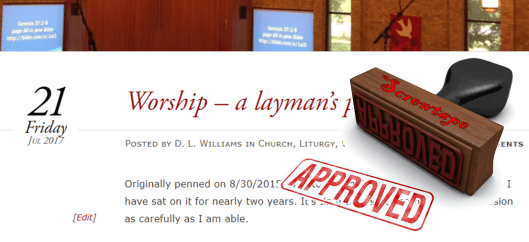
Imagine my horror, when I saw this on the dark web. It appears my post on worship has gone viral there after receiving the infamous Screwtape‘s personal stamp of approval.

At great personal risk, I have copied the text of Screwtape’s response to my post. I hope it will be beneficial to you. I know I learned a lot from reading it.

An image of my post on worship with Screwtape's stamp of approval

An image of my post on worship with Screwtape’s stamp of approval

To: My pathetic colleagues including the deficient Wormwood

From: the Inimitable Screwtape, Master of Daemons and Online Trolls

Another obscure post from another unknown blogger was brought to my attention. But it worries me slightly. Let’s use it as an example of how to avoid the good and focus on the bad. There is some risk associated with Mr. Darren’s self-righteous post, but I think we can manage it if we divert the discussions in the Parking Lot and bring in some resources from the Department of Discord.

Mister Darren starts off with some noxious clap trap about love, love, and more love. Do your best to divert anyone who happens along his blog post to skim over this part. Try to tease them into thinking this lovey talk is just the normal background noise of “churchiness” and not that he REALLY loves his church, his pastors (bleh I can hardly stand to type that word), or his youth. The word “love” stinks of the enemy, and real love is intolerable.

On to the juicy parts. I would have ignored this post altogether if Mr. Darren had not identified (accidentally, I’m sure because he doesn’t appear exceptionally bright) our two main techniques for deflating the power of worshipping the enemy – that is over emotionalism and under emotionalism. (Ugh! I hate admitting that anyone could actually worship … whatever!)

Cathartic excess and adrenaline has been one of our most effective weapons, and Mr. Darren has the gall to try to shine his little pen-light of a blog on our secret machinations. This has to be dealt with.

Likewise, he turns his little pitiful blog towards our bulwark of the disconnected recitation of mumblings that the enemy’s minions call the liturgy. He rightly points out that the words in those liturgical writings are noxious to us and are focused on the enemy.

But I’m not worried about the words in their liturgy or the words in their noxious praise songs. We have human nature on our side. And that is where I would like you to focus your efforts.

I am assigning Wormwood to lead this task. Hopefully, he won’t foul this one up.

Here is the plan.

If by chance someone stumbled upon Mr. Darren’s insignificant and pitiful blog, it is ok to let them read it. After they read it begin your work, thusly. Put the following questions into their ever-so-distractable minds:

  1. How many minutes are dedicated in a so-called worship service to their favorite categories: Contemporary vs Traditional vs Liturgical
  2. Did the worship committee pick EXACTLY the same number of contemporary songs vs old songs.
  3. Why is (organ, guitar, saxophone, trumpet, piano, drums) being used? NEVER let them listen unimpeded to the beauty of any musical offering! That beauty (bleh) is from the enemy and is very dangerous to us. Instead, get them to focus on every little missed note, off pitch, etc. These people are pretty pathetic so it is always easy to find distracting bits in the mix.
  4. Why is the pastor using that story, telling that joke, behaving that way, choosing that verse? This overly critical attitude of the “laypeople” is a new tool for us, and it is bearing some excellent fruit. Do your best to eliminate any respect of the pastors because they serve the enemy full time. There’s no telling what those fellas are up to. Especially dangerous to us are those pastors who pray together with each other and their leadership teams and who hold each other accountable. Our people cannot stand to be in the room when they are praying to the enemy, so we have difficulty knowing what they are planning.
  5. Why are we (or aren’t we) offering two worship services? We can operate effectively against the enemy in either of these situations so no matter what they choose to do, we can still distract the members to be bothered by the situation.

The one thing we CANNOT allow under any circumstances, and that is to allow the members of Faith Lutheran Church or any other church to ACTUALLY worship the enemy.

Although I couldn’t bear to read all the writings and analysis Mr. Darren pulled from the so called “holy” writings, I do know he got dangerously close to equating worship with selflessness and sacrifice. This is a very delicate situation, but Mr. Darren has given you the key to distracting a devout worshiper. Notice his martyrial tone. “I will be the one to sacrifice MY desires.” Oh brother! Take this over-dramatic selflessness and insert our secret sauce – pride.

If you can have the devout worshipers become proud of their devotion, then we can derail the whole enterprise.

That’s enough for now.

Don’t mess it up!

-Screwtape

← Older posts
Newer posts →

Subscribe

  • Entries (RSS)
  • Comments (RSS)

Archives

  • July 2025
  • November 2024
  • September 2022
  • August 2022
  • September 2020
  • July 2020
  • February 2020
  • January 2020
  • November 2019
  • September 2019
  • August 2019
  • July 2019
  • June 2019
  • April 2019
  • February 2019
  • December 2018
  • October 2018
  • August 2018
  • April 2018
  • March 2018
  • January 2018
  • December 2017
  • November 2017
  • September 2017
  • August 2017
  • July 2017
  • May 2017
  • March 2017
  • February 2017
  • January 2017
  • December 2016
  • October 2016
  • August 2016
  • May 2016
  • April 2016
  • March 2016
  • August 2015
  • February 2015
  • September 2014
  • August 2014

Categories

  • Biography
  • C.S. Lewis
  • Campus Apologetics
  • Church
  • Education
  • Grief, Death, and Dying
  • Historiography
  • Literature
  • Liturgy
  • Philosophy
  • Podcasts
  • Prayer
  • Ratio Christi
  • Reality Blog
  • Sexual Ethics
  • Uncategorized
  • Worship

Meta

  • Create account
  • Log in

Blog at WordPress.com.

Privacy & Cookies: This site uses cookies. By continuing to use this website, you agree to their use.
To find out more, including how to control cookies, see here: Cookie Policy
  • Subscribe Subscribed
    • Apologetics4all - Dr. Williams' Religion Blog
    • Join 28 other subscribers
    • Already have a WordPress.com account? Log in now.
    • Apologetics4all - Dr. Williams' Religion Blog
    • Subscribe Subscribed
    • Sign up
    • Log in
    • Report this content
    • View site in Reader
    • Manage subscriptions
    • Collapse this bar
 

Loading Comments...