• About
  • Blog Posts
  • Front Page
  • Greatest Hits

Apologetics4all – Dr. Williams' Religion Blog

~ Respectfully giving reasons for faith – 1 Peter 3:15

Apologetics4all – Dr. Williams' Religion Blog

Category Archives: Campus Apologetics

God and Miracles – Chapters 6 – 7

07 Tuesday Feb 2017

Posted by D. L. Williams in Campus Apologetics, Ratio Christi, Reality Blog

≈ 4 Comments

Tags

arguments for god, miracles

“In the beginning God…” – Genesis 1:1

The Story of Reality begins with God. God is the main character, not us. We come later.

In fact, the flow of the actual events (and of Greg’s book) follow a simple five-point outline: God, Man, Jesus, Cross, and Resurrection. We begin Part 1: God, today.

(If you are new to this series, check out the first post and the intervening posts to put this in context.)

God is the “unmoved mover (of Aristotle)”, the “greatest conceivable being (of Anselm)”, the uncreated creator, the original originator, etc.

“For from him and through him and to him are all things. To him be glory forever. Amen.” Romans 11:36

Objections and Misunderstandings

We can learn a lot by looking at common objections because most objections stem from a misunderstanding of the true nature of things.

Who Created God?

Many have smugly asked, “If God created everything, then who or what created God?”. It is shocking that this would stump a Christian. (Sadly, it does because we don’t teach our youth any apologetics. RC College Prep is trying to change that.)

Can you see the silliness in the question? Neither Christians, Jews, Muslims, nor ancient Greek polytheists like Aristotle conceive of God as a created being. The seemingly infinite regress of created things has an end, and that prior originator is what is meant philosophically and theologically by the word God. Watch these short videos of Leibniz’ Contingency Argument and Anselm’s Ontological Argument  to understand what is meant by Christians when they speak of God.

The ramifications of this are HUGE. One can intuitively grasp the observation that “If you make it, it’s yours.”

This is the basis of our Intellectual Property laws. It is also what makes people uneasy about God’s existence. If God made us we are not our own.

“16 And they sent their disciples to him, along with the Herodians, saying, “Teacher, we know that you are true and teach the way of God truthfully, and you do not care about anyone’s opinion, for you are not swayed by appearances. 17 Tell us, then, what you think. Is it lawful to pay taxes to Caesar, or not?”

18 But Jesus, aware of their malice, said, “Why put me to the test, you hypocrites? 19 Show me the coin for the tax.”

And they brought him a denarius. 20 And Jesus said to them, “Whose likeness and inscription is this?”

21 They said, “Caesar’s.”

Then he said to them, “Therefore render to Caesar the things that are Caesar’s, and to God the things that are God’s.” – Matthew 22:16-21, ESV

Here we see the ramifications of the teaching that we are made in the image of God.

“So God created man in his own image, in the image of God he created him; male and female he created them.” – Genesis 1:27, ESV

If God made you, then YOU are God’s. You are not your own. Your body and your mind are not yours to abuse or destroy or fill with drugs.

The best way to know the purpose and meaning of some invention is to ask the inventor. God has something to say about life’s purpose, meaning, and function.

The ramifications of this are immense, and they are not lost on thinking atheists.

“I had motives for not wanting the world to have a meaning; and consequently assumed that it had none, and was able without any difficulty to find satisfying reasons for this assumption. The philosopher who finds no meaning in the world is not concerned exclusively with a problem in pure metaphysics. He is also concerned to prove that there is no valid reason why he personally should not do as he wants to do. For myself, as no doubt for most of my friends, the philosophy of meaninglessness was essentially an instrument of liberation from a certain system of morality. We objected to the morality because it interfered with our sexual freedom. The supporters of this system claimed that it embodied the meaning – the Christian meaning, they insisted – of the world. There was one admirably simple method of confuting these people and justifying ourselves in our erotic revolt: we would deny that the world had any meaning whatever.” ― Aldous Huxley, Ends and Means, 1937

The problem with reality is that it catches up to you, eventually. You can jump off a building and experience a thrill, but the reality of gravity will bring the thrill to an end. Denying any meaning to life will work exactly the same way.

The next objection discussed in Greg’s book relates to miracles.

Miracles

Haven’t science and philosophy proven that miracles are impossible?

“no testimony is sufficient to establish a miracle” – David Hume, Enquiry Concerning Human Understanding, 1748

“When we run over libraries, persuaded of these principles, what havoc must we make? If we take in our hand any volume; of divinity or school metaphysics, for instance; let us ask, Does it contain any abstract reasoning concerning quantity or number? No. Does it contain any experimental reasoning concerning matter of fact and existence? No. Commit it then to the flames: For it can contain nothing but sophistry and illusion.” – Ibid. (italics added)

Scientists and philosophers have attacked miracles, for sure, but they haven’t proven that they are impossible because this would entail proving a negative.

Also, philosophers like Hume making the claim that only quantitative and experimental reasoning yield truth is odd since the sum of their work is non-empirical. Hume’s volumes would go into the flames, too. That can’t be right.

Arguing over miracles misses an important point. And it is a point you should not miss.

How did The Story begin?

“In the beginning God…” – Genesis 1:1

If you disagree with the 4th word of the Bible, then it is fruitless to argue over a virgin birth, a man swallowed by a fish, adults and children rising from the dead, healings, prophecies, angels, and demons. It also fruitless to argue over creation, meaning, sin, holiness, judgement, heaven, and hell.

But if the 4th word is true, and the rest of the phrase “created the heavens and the earth” is true, then there is nothing impossible about any of the other miracles or non-physical realities.

You may be skeptical of miracles. Fine. I’m also skeptical because I think there are many more con artists than miracle workers. But IF there is an all-powerful creator, then there REALLY is a miracle worker. How often God intervenes is up for debate, but interventions are not impossible a priori.

So let us at least look at the largest miracle ever studied.  We have LOTS of scientific evidence for it.

Let’s finish Hume’s earlier quote:

“no testimony is sufficient to establish a miracle, unless the testimony be of such a kind, that its falsehood would be more miraculous, than the fact, which it endeavors to establish.”– David Hume, Enquiry Concerning Human Understanding, 1748

Believing the universe came from nothing, or that there is a finely-tuned undetectable universe generator are both more miraculous than the simple exercise of an all-powerful non-contingent being, i.e. God.

The Point of Miracles

Lastly, if you look at the miracles of the Bible, they were not just magic tricks. They had a context and there was a point to be made or affirmed with the miracle. Here is the best example of a miracle with a point.

“2 Just then some men brought to Him a paralytic lying on a mat. Seeing their faith, Jesus told the paralytic, “Have courage, son, your sins are forgiven.”

3 At this, some of the scribes said among themselves, “He’s blaspheming! ”

4 But perceiving their thoughts, Jesus said, “Why are you thinking evil things in your hearts? 5 For which is easier: to say, ‘Your sins are forgiven,’ or to say, ‘Get up and walk’? 6 But so you may know that the Son of Man has authority on earth to forgive sins” — then He told the paralytic, “Get up, pick up your mat, and go home.”

7 And he got up and went home.” – Matthew 9:2-7, HCSB

THAT’s a mic-drop moment.

To participate in this discussion, comment below.

Or if you are on the SHSU campus this spring (2017), come discuss this book with our Ratio Christi at SHSU chapter that meets Fridays at Noon in LSC 307. Bring your lunch and feed your soul.


≪Previous | Next ≫

A Non-objective Objection – Chapter 4

30 Monday Jan 2017

Posted by D. L. Williams in Campus Apologetics, Reality Blog

≈ 3 Comments

Most agree the world is not as (we think) it should be. Something is broken. If God exists, was he powerless to keep it from being broken?

Greg uses a concise illustration.

“When the trains are running on schedule, it’s likely because the person at the switchboard is doing his job. But when things consistently go awry, it’s reasonable to ask if anyone is minding the controls at all.” P 35.

I like this analogy because I have seen the Fort Worth Train Yard.

clip-ftworthtrainyard

Fort Worth Train Yard by Linda Ungar (http://fineartamerica.com/featured/fort-worth-trainyards-linda-unger.html )

But maybe trains are far from your experience. So let’s use another analogy.

“When the Texas Longhorn Football Team is undefeated and in the running for a National Championship, it’s likely because the Head Coach is doing his job. But when things consistently go awry with the typically excellent players recruited by The University, it’s reasonable to ask if anyone is minding the playbook, organizing the practices, or preparing the team at all.

In fact, this thought can be generalized:

When _something “good” happens_, it’s likely because _the person in charge_ is doing what I think should be done. But when _something “bad” happens_, it’s reasonable to ask _if anyone’s in charge, or if someone’s in charge, why they don’t care_?

This is one place where skeptics know some Christian doctrine. They know that the Bible teaches that God is good. They also know that the Bible teaches that God is omnipotent (all powerful). They often claim the existence of moral and natural evil (a broken world) exposes an inconsistency:

  • A good God would not allow the world “to break”.
  • A powerful God could stop the breaking of His world.

What is interesting in this objection is the fact that upon atheism, there is no objective definition of “good”, “evil”, “broken” or “unbroken” worlds. The world just “IS”.

“The total amount of suffering per year in the natural world is beyond all decent contemplation. During the minute that it takes me to compose this sentence, thousands of animals are being eaten alive, many others are running for their lives, whimpering with fear, others are slowly being devoured from within by rasping parasites, thousands of all kinds are dying of starvation, thirst, and disease. It must be so. If there ever is a time of plenty, this very fact will automatically lead to an increase in the population until the natural state of starvation and misery is restored. In a universe of electrons and selfish genes, blind physical forces and genetic replication, some people are going to get hurt, other people are going to get lucky, and you won’t find any rhyme or reason in it, nor any justice. The universe that we observe has precisely the properties we should expect if there is, at bottom, no design, no purpose, no evil, no good, nothing but pitiless indifference.”― Richard Dawkins, River Out of Eden: A Darwinian View of Life

If there is no suffering, no fear, no reason, no justice, no design, no purpose, no evil,  and no good, then there is absolutely nothing to complain about.

In atheism, these categories have no true meaning if we are just bags of bones and chemicals.

However, we know deep down that suffering exists, that things really ARE broken, and that things really SHOULD be different, better, and “fixed”. The Christian story of reality contains reasons for this state of affairs without eliminating God’s goodness or limiting His power.

The Christian story tells how WE rebelled. WE and our ancestors consistently rejected the proper order for our own selfish goals. What a mess it has made.

You see, God is not responsible for the evil in the world. We are.

We also complain about God not doing anything about it. But He has. We will learn about His solution as we proceed through the book.

For a short version of God’s solution watch this excellent video. Is God good?

clip-isgodgood

To participate in this discussion, comment below.

Or if you are on the SHSU campus this spring (2017), come discuss this book with our Ratio Christi at SHSU chapter that meets Fridays at Noon in LSC 307. Bring your lunch and feed your soul.

<< Previous | Next >>

Reality Blog – Cemented Faith (Chapters 3 and 5)

04 Wednesday Jan 2017

Posted by D. L. Williams in Campus Apologetics, Reality Blog

≈ 7 Comments

7882810002_large

My sweet ride in 1984.

Regarding Stories – True or False – Fact or Fantasy

Out of school early with my own driver’s license and a car. Sure, I was headed to a doctor’s appointment for my sprained ankle, but the point was the sense of freedom I felt driving myself around. Two months of solo driving and the thrill had not worn off.

Safety was always a big deal with me. I thought of taking Long Ave, but the turn onto 199 was not a protected left. So I stayed on River Oaks Blvd. It was a big and safe intersection with two protected left turn lanes. I was in the leftmost one in the front of the line.

Green arrow, let’s go. I pulled out at a moderate pace and noticed an enormous cement truck crossing the white line in the oncoming lane. I slammed the brake pedal to the floor causing my car to quickly stop. Then, I realized that stopping wasn’t going to help. I was in his path, and he was still headed my way.

Notice, the beginning of this story.

I didn’t start it with “Once upon a time” or “A long time ago in a galaxy far, far away…”. No, I am writing this story in a deliberate manner to convey that it is a real life, true, and actual occurrence in my life. It is fact, not fantasy. It happened in November 1984. I can’t remember the exact day, but I bet my mom and dad can.

Stories can be true or false, fact or fantasy. This is an ongoing blog series on Greg Koukl’s book, “The Story of Reality”. Get the book. Begin at Part 1. And participate in the discussion by posting comments on the various posts.

When you first read Greg’s title, “The Story of Reality”, what did you think of it? Did you automatically put it in the category of fiction or fantasy? Answer below in the comments so we can discuss it. (Remember, this is asynchronous interaction, so don’t worry about being late to the party. These internet discussions do not have any preset time limit.)

Back to my 1973 Oldsmobile Cutlass Supreme.

I knew I was stopped. I knew the cement truck was not. I knew it was massive. I knew this was the end.

So I relaxed.

What? How could someone relax in a situation like that?

I simply thought, “Hey, I’m outta here. I’m dead, and now I’m free, headed heavenward. No more basketball practice with Coach John Doe*. Jesus, here I come.”

I didn’t feel anything. I’m sure I got bounced around violently. I had a rectangular knot on my forehead from the rearview mirror, and my hip bent the gearshift. But after the car stopped spinning around, I opened my eyes to smoke, steam, and a destroyed windshield. The cement truck had crushed my car from the right-front headlight to the driver’s side door.

Funny, my first thought was “Crud, I’m still here.” Even funnier was my second thought, “Hey I better get out of this wreck before it blows up.” I was imagining a Hollywood style conflagration.

The door opened and dragged against the pavement. I hobbled over to the curb to sit down. Sadness ensued as I looked at my car all destroyed and smoking. I was sparkling Edward-Cullen-style with pulverized glass from the windshield.

Hours and seventeen X-rays later it was determined that I did not have a single broken bone or laceration. To play it safe, the doctors told mom to wake me every two hours because of a possible concussion. It didn’t sink in how severe the wreck was until I overheard mom reading police reports from eyewitnesses.

The woman in a car immediately behind me said, “After the explosion, I got out of my car to pull the body from the wreckage.”

The body! She thought I was “a dead body”.

Strangely, it was then that I started crying. I sobbed. It was her perspective that alerted me to the severity of the wreck that I survived.

All because I relaxed.

What are my intentions in telling you this true story?

It is NOT to brag about strong faith. I didn’t have to exert any strength or psych up extra courage.

It is NOT to make a claim that my experience proves God is real, heaven is real, or fear of death makes one weak.

My intentions are:

  1. To get you to consider how life-changing a TRUE story can be.
  2. To illustrate how being convinced is actually effortless.

Being raised in the church (specifically Saint Andrew’s Episcopal Church in Fort Worth, TX), there were ample opportunities to “make my faith my own.” I did that in 5th grade when I read the Sermon on the Mount (Matthew 5-7), and thought to myself, “uh-oh. I don’t stack up too well. Jesus forgive me.” That conviction was a gift, and being convinced of my lack took no effort on my part. (John 16:8-11)

Life has ups and downs and so does behavior. I was not an angel. I am deeply sorry for the horrible ways I treated some of my classmates and teachers. (If you remember, please forgive me.)

Back to the cement truck story.

It is a FACT that I relaxed. It is a FACT that my first thought was one of relief when considering my eternal destiny. This TRUE story affects me even today.

I do still fear airplane crashes, head-on collisions, and other painful ways of leaving this material world behind. But I still remember the crash of 1984. It wasn’t painful. It wasn’t scary. It was in FACT a hopeful experience.

What kind of God gives REAL peace? A REAL God?

[John 14:27 HCSB] 27 “Peace I leave with you. My peace I give to you. I do not give to you as the world gives. Your heart must not be troubled or fearful.”

Could it be that a REAL God exists? Could it be that Jesus was unique in all of history, and that his claims were TRUE?

A REAL God requires a TRUE story.

Greg is telling that TRUE story in his book.

I hope you will read it, discuss it, and be transformed by its message.

-Darren


*I changed the name so as to not hurt the actual coach.

<<Previous Post | Next Post >>

Reality Blog – The Puzzle – Chapter 2

22 Thursday Dec 2016

Posted by D. L. Williams in Campus Apologetics, Reality Blog

≈ 4 Comments

This is an online blog of Greg Koukl’s book, The Story of Reality. It should be taken as an online book club discussion. So, get your copy, start at the beginning.  and contribute in the comments section. Subscribe for updates so you’ll know when the next post appears.

I’m trying today’s post from the phone app, so forgive any thumb-induced typos.

Puzzle

We just received a puzzle as a gift for Christmas from our neighbors. We enjoy them as a family but they take time and commitment. Especially a 1000 piece puzzle like this one.

You have to set aside a space for the puzzle. We use a card table.

You need good lighting.

We use puzzles as a social time where many eyes can look through the pieces and discuss where we think they fit best. (Protip: puzzles are one of the few remaining screen-free family activities. And often deep conversations ensue.)

Greg’s example of the worldview puzzle fits nicely into this scheme.

Space. When analyzing your own worldview, you must think about how you think. (This is meta cognition, and is one unique aspect of humanity.) Thinking about thinking requires mental space and space in your schedule. It is my hope that you will set aside some space every day or week to study your worldview. That is why I’m doing this blog series. I’m clearing some space in my calendar to encourage you to clear some space in yours. I trust Greg, so I figured his book would be a good place for you to start if you have never thought much about these things.

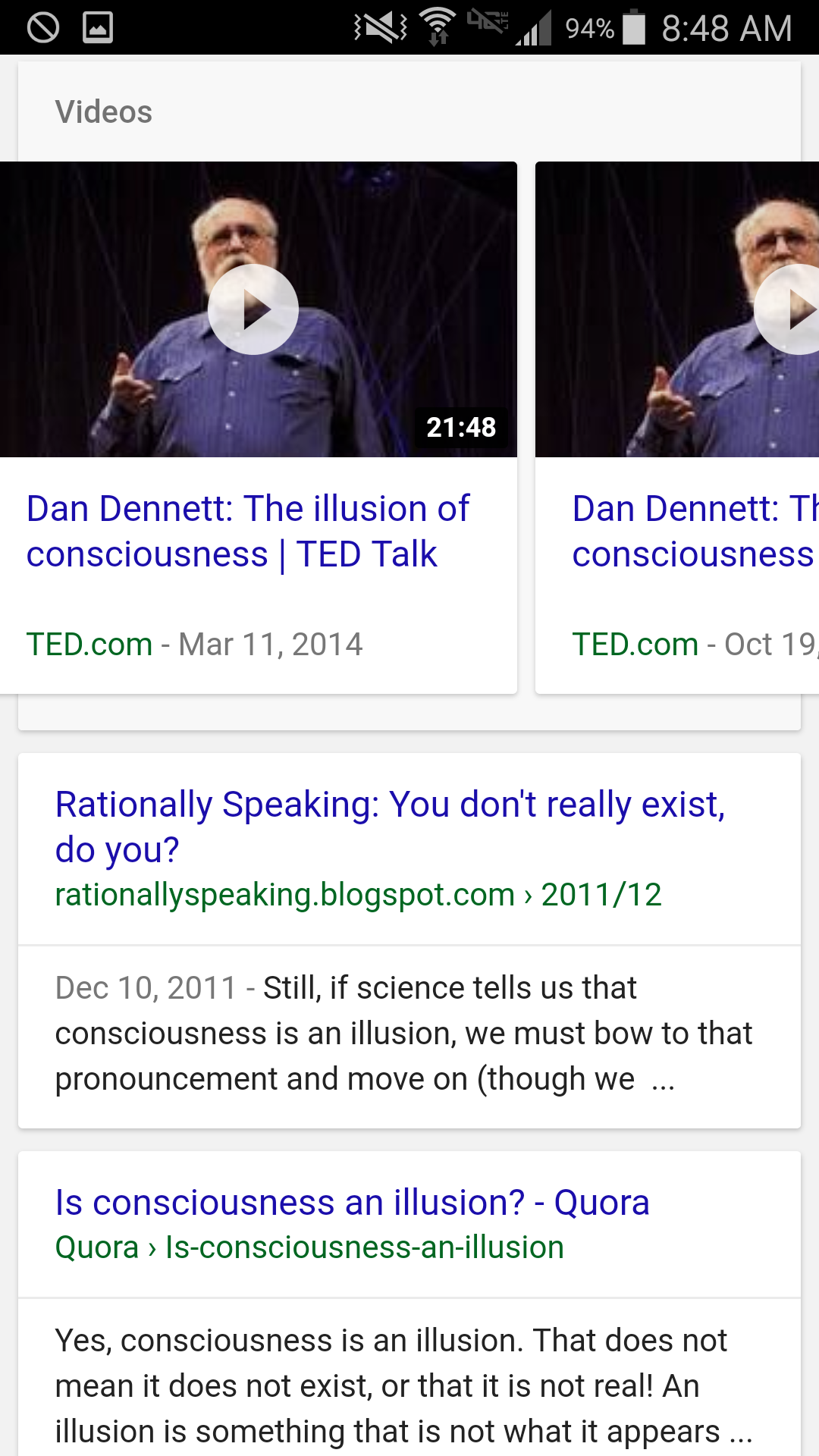
Lighting. In my puzzle scheme, what does good lighting look like? When thinking about thinking, good lighting is a commitment to the TRUTH. You don’t want to have to force pieces together, nor do you want a distorted view of reality. Take for example the many vocal and (partially) logically-consistent atheists who take atheism to its logical conclusion that consciousness is an illusion. They are very persuasive. I mean, they’ve given TED talks so they must be right. Right?

This is the opposite of light. They are telling you that you get to make up your own picture on the front of your own puzzle box. The Bible speaks about this most clearly in Paul’s letter to the Romans.

For though they knew God, they did not glorify Him as God or show gratitude. Instead, their thinking became nonsense, and their senseless minds were darkened. Claiming to be wise, they became fools.

I want to focus on the foolishness of claiming that consciousness is an illusion. Is Daniel Dennett conscious of his illusive consciousness? What light is illuminating his worldview puzzle? And without consciousness, it is foolish to talk of science or facts. The world is unknowable because there is no “knowing”. Foolish, indeed.

(Caveat. I’m not using ridicule as an argument against Dennett. I am pointing out that using consciousness to argue against consciousness is self-refuting folly.)

Social Time. Lastly, there is a social aspect to this puzzling about worldview puzzles. I’m attempting to create some social interaction on the topic through this blog for those who are geographically isolated like I am. But if you get a chance look for a Ratio Christi chapter if you are near a college campus, or a Reasonable Faith chapter, or a Reasons to Believe chapter in your town. These are awesome places with friendly puzzlers who would love to discuss the search for truth with you.

Let me know if you are plugged into one of these groups, and what you think of them in the comments section.

<<Previous Post | Next Post >>

Reality Blog – Preface and Chapter 1

21 Wednesday Dec 2016

Posted by D. L. Williams in Campus Apologetics, Reality Blog

≈ 4 Comments

This is an online book club discussion of Greg Koukl’s latest book “The Story of Reality: How the world began, how it ends, and everything important that happens in between.”

Start at the beginning to catch up.

Preface

“There are reasons for the way things are.”

We know this, which is why we ask “why”.

“As we get older, asking “Why?” goes deeper into the heart of things. We begin asking the question not of any individual think, but of the whole thing. What is the reason for everything? Why am I here? Why is anything here? Why is anything important or good or beautiful? Why?”, p. 17

Or as we have recently lost a dear family member, we ask “Why was his life cut short?”

The nihilist* says that there is no “real” purpose, and the answer to the “why question” is “why not?” A popular book by John Green The Fault in Our Stars gives a nihilist perspective throughout. The youth in his story are dying of cancer and try to reject nihilism by making up their own purpose for life, which consists of close friendships and cathartic emotional release. If you saw the movie, they are left with merely being “OK” with it all. If you’ve read Green’s book, you’ll enjoy this.

*Definition of nihilism: 1.a: a viewpoint that traditional values and beliefs are unfounded and that existence is senseless and useless – “Nihilism.” Merriam-Webster.com. Merriam-Webster, n.d. Web. 21 Dec. 2016.

Chapter 1 – Confusion

Is Christianity any better? Is nihilism the truth and religion merely a very elaborate plan to deceive ourselves with a made-up purpose? Greg outlines this modern (but false) approach to religion on page 22.

“Find the club you like – the one that meets your personal needs, that gives you rules to live by that are respectable but not too demanding, that warms your heart with a feeling of spirituality. That’s the point of religion. Do not, however, confuse religious stories with reality. They don’t give you that kind of information about the world that, say, science does. Yes, believing in God is useful to a point, but religion taken too seriously is, in some ways, like believing in Santa Claus – quaint if you’re a child but unbecoming of an adult.” p. 22

This view is essentially Marx’s dictum that “religion is the opiate of the people”. It is very common even if not stated explicitly by neighbors and colleagues. And it is stated explicitly by many debaters and authors. For example, Philip Kitcher writes in Living with Darwin,

“There is truth in Marx’s dictum that religion, more precisely supernaturalist and providentialist religion, is the opium of the people, but the consumption should be seen as medical rather than recreational. The most ardent apostles of science and reason recommend immediate withdrawal of the drug – but they do not acknowledge the pain that would be left unpalliated, pain too intense for their stark atheism to be a viable solution.” (Kindle Location 1626 of 1862), OUP 2007.

Kitcher wants religion to flourish as a community-building useful fiction, but he wants to rid it of any claim to reality.

Greg disagrees, and in his book, makes the bold claim that,

“Christianity is a picture of reality.”, p. 23

Christianity is an all-encompassing worldview among many others. And in this book Greg is walking us through the process of evaluating how the “many puzzle pieces of life” fit together if Christianity is the “picture on the front of the puzzle box”. Likewise, fewer of life’s puzzle pieces fit together if a different worldview is used as the picture on the front of the box. That’s where we are headed in Chapter 2. Next time.

Give me your thoughts in the comments. Buy your copy of Greg’s book so we can have substantive discussions. (Again, I get nothing from his book sales.) And if I get behind, start your own blog post on the topic so we can get into dialog. It’s easy. – DLW

<<Previous Post | Next Post >>

Live-blog of the Story of Reality

20 Tuesday Dec 2016

Posted by D. L. Williams in Campus Apologetics, Reality Blog

≈ 14 Comments

I just received the much anticipated book by Greg Koukl – “The Story of Reality: How the world began, how it ends, and everything important that happens in between“.

Why would I be so excited?

  1. His book “Tactics” actually taught me how to listen to others when they are speaking. Before Greg’s influence, I spent that precious time formulating my next point instead of hearing what the person is actually saying.
  2. His podcasts have served a mentoring role for me for about 4 years.
  3. His team at Stand to Reason has informed me with their articles, talks, videos, and other resources.

Therefore, I am eager to read through Greg’s magnum opus (to use his phrase). I caught a glimpse of his view of the big picture in his DVD series “The Bible Fast Forward“. The title implies a quick treatment, but not so. This was a comprehensive treatment with a huge pdf outline.

What is a “live blog” of a book?

Well, I have heard of people participating in book clubs where several readers of the same book get together to discuss a chapter at a time. Either, my town is too small, or we are all too busy to do such an enjoyable thing, or I simply have not located enough like-interested individuals in my vicinity to form such a group. So I’ll do my part on the Internet. And if you get your copy of Koukl’s book, you can chime in at your leisure in the comments section.

We can form our own book club.

Although I may put some quotes in my blog, I will not reproduce the whole thing here. That would be illegal and worse, would harm Greg by stealing his labor. You will not be able to skip reading it for yourself, so go ahead and buy your own copy. It will make our shared experience better and our discussion deeper. (BTW, I am not benefiting from the sale of his books.)

One last caveat on time. We are entering the Christmas season, and I have a huge vista of time ahead. But that does not mean that I will spend all of it reading a book or blogging. So cut me some slack if these posts are sporadic. If you get ahead of me in the reading, then open up your own WordPress page and blog the chapters on your site. I’ll check them out when I find time and then we will really be in DIALOG. That would be GREAT!

Lastly, I probably only have an hour to devote to this, and today’s hour is up. If this interests you at all, please say so in the comments and subscribe to this blog so you will receive a notification when I post my comments on the Preface and on Chapter 1 – Confusion. (Tomorrow, Lord willing…) For now, how about a teaser quote from the Preface:

“As we get older, asking “Why?” goes deeper into the heart of things. We begin asking the question not of any individual thing, but of the whole thing. What is the reason for everything? Why am I here? Why is anything here? Why is anything important or good or beautiful? Why?” – Greg Koukl, The Story of Reality, p17

Next Post >>

The Fault in Our Stars – A Conversation

22 Monday Aug 2016

Posted by D. L. Williams in Campus Apologetics, Literature

≈ 3 Comments

Tags

Cancer, faith, hope, pain

This conversation will contain spoilers.  If that bothers you, then go read the book first.  In fact, if you haven’t read the book, this conversation will make no sense at all.

The Scenario

Kathy read The Fault in Our Stars in her 8th grade Language Arts class.  The teacher and the class loved to discuss the issues raised in the book.  When the movie appeared in theaters she regaled her father Jim with stories of her friends taking boxes of Kleenex to the show.

He asked, “Is it THAT sad?”

Kathy replied, “Oh, yes!  It is about cancer and everybody dies.  It is a love story.  My whole class loved the book!”

“You’re kidding.  It sounds literally tragic, Shakespearean, in fact.”

“How’d you guess?  The title is a quote from Shakespeare.”

“Is it the star-crossed lovers Romeo and Juliet?”

“A pair of star-cross’d lovers take their life;
Whose misadventured piteous overthrows
Do with their death bury their parents’ strife.”

–Act 1, Prologue, Romeo and Juliet

Kathy, “No.”

“This is the excellent foppery of the world, that,
when we are sick in fortune,–often the surfeit
of our own behavior,–we make guilty of our
disasters the sun, the moon, and the stars: as
if we were villains by necessity; fools by
heavenly compulsion; knaves, thieves, and
treachers, by spherical predominance;”

–Act 1, Scene 2, King Lear

Kathy grinned, “No.  But close.”

Jim clapped, “Ah, you said it was a love story!”

“That I should love a bright particular star
And think to wed it, he is so above me:
In his bright radiance and collateral light
Must I be comforted, not in his sphere.”

–Act 1, Scene 1, All’s Well That Ends Well

“Love and Death in the opening scene!”, cheered Jim.

“Here, just read the book for Pete’s sake.”, groaned Kathy.

————–<two days pass>————–

Jim commented, “Good book!”

Kathy replied, “I was worried you wouldn’t like it.  Honest!  Did you cry?”

“No comment.”

“You cried.  What part got you the most?”

“I don’t know.  What part got you the most?

“You first.”

“No, you read the book first, so you go first.”

“That’s a lame reason.  But, I’ll go first, anyway.”, said Kathy.

<As with real conversations and TV episodes, rarely do you get the whole experience in one setting.  Also, the author of this fictional conversation has a real job and a time-consuming schedule.  He will pick up where he left off next time.  Read Part II.>

*John Green, The Fault in Our Stars, Dutton Books, New York, NY, 2012.
Republished from the Ratio Christi Blog with permission.

What I Believe and Why

05 Tuesday Apr 2016

Posted by D. L. Williams in Biography, Campus Apologetics, Church, Ratio Christi

≈ 10 Comments

As Director of Ratio Christi at SHSU, I am always collecting “tough questions”. I want to be sure I am addressing the deepest questions that are percolating below the surface of the students’ calm and cool demeanor.

I also challenge the students to be ready to answer the First Question – “What do you believe and why do you believe it?” So I thought I would put down my answer to this question in blog post form, for them and for you.

Q:           “What do you believe and why do you believe it?”

A:           I’ll answer this in two parts since it is a two part question.

Part 1: What do you believe?

This question is easy to answer in some respects, because it is one that has been at the heart of the church for 2000 years. Since the beginning of the church at Pentecost (Acts 2), the Apostles began spreading the Gospel in Jerusalem, Judea, Samaria, and the world.

The early Christian Creeds were succinct statements of the Gospel. Take one of the earliest creedal statements as an example,

“For I delivered to you as of first importance what I also received,

  • that Christ
    • died for our sins in accordance with the scriptures,
    • that he was buried,
    • that he was raised on the third day in accordance with the scriptures, and
    • that he appeared to Cephas, then to the twelve.” – 1 Corinthians 15: 3-6

I have written it in outline form, which is a useful practice when it comes to creeds. This statement is both an eyewitness report that Jesus bodily rose from the dead, and a theological statement that he died for our sins as predicted by the scriptures (Isaiah 53; Watch this amazing dialog about Isaiah 53 in Israel ).

The creeds grew from very simple to quite elaborate as the Church wrestled with finer theological points. But there is broad agreement that the Apostles’ Creed captures the foundational essentials of orthodox Christianity. To deviate from them is to deviate from Christianity. (In this usage orthodox is to mean authentic, not Eastern Orthodox, etc.)

The Apostles’ Creed

  • I believe in God the Father
    • Almighty,
    • Creator of heaven and earth.
  • I believe in Jesus Christ,
    • his only Son,
    • our Lord.
    • He was conceived by the power of the Holy Spirit
    • and born of the Virgin Mary.
    • He suffered under Pontius Pilate,
    • was crucified,
    • died and
    • was buried.
    • He descended to the dead.
    • On the third day he rose again.
    • He ascended into heaven, and
    • is seated at the right hand of the Father.
    • He will come again to judge the living and the dead.
  • I believe in the Holy Spirit,
  • the holy catholic Church,
  • the communion of saints,
  • the forgiveness of sins,
  • the resurrection of the body, and
  • life everlasting.

Notice how most of the Creed is centered on our physical and temporal experience of “God with us” which is Isaiah’s prophesied name of the Messiah (Isaiah 7:14 and Matthew 1:23). Many of these claims are evidential, observable, and testable (at least at the time). Others are theological. All of these claims are Biblical. In fact, there is an EXTENSIVE Bible study on the Apostles Creed here.

And J. Warner Wallace has a nice blog post on early Christian creeds and confessions of faith.

So as a Christian, my simple answer to “What do you believe?” is given to me and to you in the Apostles’ Creed.

Part 2: Why do you believe it?

The “Why do you believe it?” question is subjective and personal. But this is where the conversation gets interesting, especially if we want to discuss our beliefs with others (i.e. evangelism).

Why would I believe some of the outlandish things put forth in the Apostles’ Creed?

My answer has changed over the years, but it has grown stronger, and I think, more compelling. Here is a timeline:

1968 – 73: Infancy and early childhood, I would have no answer to the “why” question, except “my family goes to church”, or “Jesus loves me, this I know, for the Bible tells me so.” from the familiar hymn.

1974 – 80: Through the Sunday school program at St. Andrew’s Episcopal Church in Fort Worth, TX,  I began reading the Bible on my own time, as this was encouraged by my excellent Sunday School teachers. My answer at that time for “why do you believe it?” would have been “because it is in the Bible”.

This is a good answer, by the way. But it requires a second layer of defense, namely an answer to the question, “Why do you believe the Bible is reliable?”

1981 – 92: Through high school and my bachelor’s degree at UT Austin, my faith became more experiential. Emotionally moving worship experiences in both liturgical settings and contemporary settings helped me feel a connection to God. Summer camps, the Baptist student ministry, Chi Alpha at UT, FCA, Longhorn Band Bible study, and ski trips created close knit connections to the Church – the body of believers and the body of Christ on Earth.

My answer for “why do you believe it?” was as warranted as any other belief about a real person. I believed in God because I had “met Him” – in prayer, in worship, in service, in fellowship, and in the church.

This is also a good answer. It is internal confirmation of the Apostles’ Creed articles about the “Holy Spirit” and the “church”. It cannot be easily argued against, because it is experiential.

But it is not very compelling to some because it is experiential. They may not believe that my experience is an indicator of reality about God. I could be deceived or even acculturated to create these feelings in myself to fit into my chosen group – the church.

1993 – present: As a graduate student in Oregon – a very secular part of the country – I was able to see Christianity from “the outside” through the eyes of non-Christians who I met in the billion or so coffee shops and microbreweries in the Northwest. They were happy to let me have my subjective experiential Christian faith. But they were not convinced.

I began to read more Christian apologetics and found a treasure trove of books about and by atheists who became Christians. (For example, my Ratio Christi colleague Joel Furches has blogged about many atheist converts to Christianity, and it was apparently EASY for him to find examples.)

Many of these atheists sought to make an objective and evidential case against Christianity, because they had only heard subjective and emotional arguments like mine such as: – “Christianity is a relationship. Christianity works for me. If you ask me how I know He lives, He lives… within… my heart. (as the hymn goes)”.

I was energized to learn from these converts to Christianity. Their evidential approach convinced them that the Christian truth claims were actually True. I did my best to look at their arguments with “outside eyes”, and I continue to find their arguments compelling.

You may accuse me of confirmation bias, but making an accusation is not the same as making an argument.

Therefore, at the present time, here is my answer to “Why do you believe it?”

  1. The universe had a beginning, and thus must have a cause that was immaterial, powerful, infinitely precise, beyond our conception of time.

The evidence for this comes from astrophysics and cosmology. It essentially gives evidence for the first article of the Apostles’ Creed “God almighty creator of heaven and earth”.

  1. Jesus of Nazareth is a pivotal character in world history.

The claims about him only make sense if he supernaturally rose from the dead. Many of these facts are confirmed using sources outside the Bible. Consider this research using ONLY non-Christian sources done by J. Warner Wallace – an atheist homicide detective who became a Christian after his research.

  1. Warner Wallace writes:

“Let’s review what we’ve learned from hostile pagan and Jewish sources describing Jesus. We’ll do our best to discount the anti-Christian bias we see in the sources, just as we discounted the pro-Christian bias we think might exist in some versions of the writing of Josephus. Many elements of the Biblical record are confirmed by these hostile accounts, in spite of the fact they deny the supernatural power of Jesus:

Jesus was born and lived in Palestine. He was born, supposedly, to a virgin and had an earthly father who was a carpenter. He was a teacher who taught that through repentance and belief, all followers would become brothers and sisters. He led the Jews away from their beliefs. He was a wise man who claimed to be God and the Messiah. He had unusual magical powers and performed miraculous deeds. He healed the lame. He accurately predicted the future. He was persecuted by the Jews for what He said, betrayed by Judah Iskarioto. He was beaten with rods, forced to drink vinegar and wear a crown of thorns. He was crucified on the eve of the Passover and this crucifixion occurred under the direction of Pontius Pilate, during the time of Tiberius. On the day of His crucifixion, the sky grew dark and there was an earthquake. Afterward, He was buried in a tomb and the tomb was later found to be empty. He appeared to His disciples resurrected from the grave and showed them His wounds. These disciples then told others Jesus was resurrected and ascended into heaven. Jesus’ disciples and followers upheld a high moral code. One of them was named Matthai. The disciples were also persecuted for their faith but were martyred without changing their claims. They met regularly to worship Jesus, even after His death.

Not bad, given this information is coming from ancient accounts hostile to the Biblical record. While these non-Christian sources interpret the claims of Christianity differently, they affirm the initial, evidential claims of the Biblical authors (much like those who interpret the evidence related to Kennedy’s assassination and the Twin Tower attacks come to different conclusions but affirm the basic facts of the historical events). Is there any evidence for Jesus outside the Bible? Yes, and the ancient non-Christian interpretations (and critical commentaries) of the Gospel accounts serve to strengthen the core claims of the New Testament.” –JWW

So without even using the Bible, we could confirm the main points of the second article of the Apostles’ Creed.

This is the center pole of the tent of Christianity. If Jesus is who he claims to be, then we get ALL OF SCRIPTURE in the mix. He quotes the Old Testament. The reason why he came is prophesied in the Old Testament.

These prophesies MUST BE FALSE if there is no God, and only nature exists. But if Jesus rose SUPERNATURALLY from the dead, then there is a supernatural realm, and the Bible becomes the best source for learning about God, the Holy Spirit, and all the other theological points – not because we like it, but because archaeology affirms the Biblical accounts over and over again.

  1. There REALLY is a right and wrong.
    1. Objective moral laws require a moral lawgiver with authority, namely God.
    2. Objective moral laws exist.
    3. Therefore, a moral lawgiver with authority (God) exists.

This syllogism is invincible. In fact, one can find atheists who support a. and deny b. And one can find atheists who support b. and deny a. One rarely finds an atheist who supports both a. and b. because that would make them a theist, or an internally conflicted atheist who ignores his own cognitive dissonance. (This is not much of a slight, though. We all tend to suppress cognitive dissonance. Hopefully, this post is causing some positive cognitive dissonance, for you.)

This moral framework is evidence for portions of the Apostles’ Creed as well – “at the right hand of the Father” (authority), “judge the living and the dead” (moral law breakers), “forgiveness of sins” (reconciliation with God), “everlasting life” (eternal reconciliation with God).

In Summary

What do you believe? – The Apostles’ Creed is a concise statement of my Christian convictions. I also accept the Nicene Creed, the Athanasian Creed, and the Augsburg Confession, and I am a member of Faith Lutheran Church LCMS in Huntsville, Texas.

Why do you believe it? – It is the best evidential description of reality – the way the world ACTUALLY is.

Bonus question,

What does this mean?

Wow! This means God REALLY loves me and YOU. We have been in rebellion against him through our self-centered desires. This rebellion will eventually lead to our permanent rejection of all Godly things – the antithesis of love, joy, peace, patience, kindness, goodness, faithfulness, gentleness, and self-control. But God himself took the punishment we deserved, thus healing the sickness of sin that brings death. All we must do is consider the claims of the Apostles’ Creed – that through Jesus’ death and resurrection, our dead bodies can be made newly alive. If we accept the cure that he provides, we will live.

If you don’t believe it, yet, that’s understandable. But chew on it.

Don’t ignore your questions. Ignoring spiritual questions is worse than ignoring chest pain.

Image: Time Flies (tempus fugit)

By Nheyob – Own work, CC BY-SA 4.0


Tempus fugit.

Darren

Stopping the Exodus

31 Thursday Mar 2016

Posted by D. L. Williams in Campus Apologetics

≈ Leave a comment

Tags

College Apologetics, Ratio Christi, Student Apologetics, Youth Retreats

You have heard dismal news.2016-stopping-the-exodus

  • 70 % of youth leave the church in college.

As we sound the alarm in our congregations, think of what the youth are thinking.

  • Is this the way it is supposed to be?
  • Will I make it through college with MY faith in tact?

Here is some good news:

  • The 70% exodus from church is overstated.

This research revealed that many of the 70% merely take a hiatus from regular church attendance during the college years. There are many factors which drive this. Some of which are good, not bad.

For instance, many students are very active in para-church ministries, which technically are not church, and would not be seen as regular church attendance. I have been involved with these students and these ministries for years at multiple campuses. The spiritual needs of these students are being met with regular worship, small group Bible study, discipleship groups, service projects, and Christian outreach. These students go on to more stable lives and return to church when jobs, marriages, and kids come along.

That is NOT to say that there is no exodus. There is. But it is not 70%.

Here is some better news:

  • We know the traits of those students who DON’T leave the church during the college years?
  1. They REALLY are Christians, and were not just in youth group for the pizza.
  2. They were equipped by their youth program, not just entertained.
  3. Their parents preached the gospel to them.

Here is some BETTER news.

Ratio Christi College Prep (RCCP) exists to train mentor youth leaders to run high school apologetics clubs within the church or school. The purpose of these clubs is to:

  1. Disciple the youth, helping them become confident in their Christian convictions.
  2. Equip the youth, helping them be comfortable in ANY conversation with ANY person about ANY topic related to the Christian faith.

Contact me to set up a training in your area. I’ll put you in contact with the RCCP Coordinator.

And for you in Huntsville, Texas, here is the BEST NEWS!

We are hosting a High School Retreat to:

  1. EQUIP your kids.
  2. ENCOURAGE their faith in Christ.
  3. ENABLE them to confidently meet future challenges.

Your youth will meet college mentors from SHSU who have NOT lost their faith in college. Instead, these college students have grown closer to the Lord through Bible study and through the study of Christian Apologetics – the Rational Defense of the Faith.

That’s what Ratio Christi is all about.

I sincerely hope you will support us by telling the youth in YOUR church to attend our High School Retreat on April 16, 2016.

All they have to do to sign up is text “@16retreat” to 81010.

The High School Retreat landing page is here.

God bless you and your youth.

-Darren

dw8

Newer posts →

Subscribe

  • Entries (RSS)
  • Comments (RSS)

Archives

  • July 2025
  • November 2024
  • September 2022
  • August 2022
  • September 2020
  • July 2020
  • February 2020
  • January 2020
  • November 2019
  • September 2019
  • August 2019
  • July 2019
  • June 2019
  • April 2019
  • February 2019
  • December 2018
  • October 2018
  • August 2018
  • April 2018
  • March 2018
  • January 2018
  • December 2017
  • November 2017
  • September 2017
  • August 2017
  • July 2017
  • May 2017
  • March 2017
  • February 2017
  • January 2017
  • December 2016
  • October 2016
  • August 2016
  • May 2016
  • April 2016
  • March 2016
  • August 2015
  • February 2015
  • September 2014
  • August 2014

Categories

  • Biography
  • C.S. Lewis
  • Campus Apologetics
  • Church
  • Education
  • Grief, Death, and Dying
  • Historiography
  • Literature
  • Liturgy
  • Philosophy
  • Podcasts
  • Prayer
  • Ratio Christi
  • Reality Blog
  • Sexual Ethics
  • Uncategorized
  • Worship

Meta

  • Create account
  • Log in

Create a free website or blog at WordPress.com.

Privacy & Cookies: This site uses cookies. By continuing to use this website, you agree to their use.
To find out more, including how to control cookies, see here: Cookie Policy
  • Subscribe Subscribed
    • Apologetics4all - Dr. Williams' Religion Blog
    • Join 28 other subscribers
    • Already have a WordPress.com account? Log in now.
    • Apologetics4all - Dr. Williams' Religion Blog
    • Subscribe Subscribed
    • Sign up
    • Log in
    • Report this content
    • View site in Reader
    • Manage subscriptions
    • Collapse this bar
 

Loading Comments...