
• About
  • Blog Posts
  • Front Page
  • Greatest Hits

Apologetics4all – Dr. Williams' Religion Blog

~ Respectfully giving reasons for faith – 1 Peter 3:15

Apologetics4all – Dr. Williams' Religion Blog

Category Archives: Campus Apologetics

No Blind Faith – Part 3

14 Sunday Apr 2019

Posted by D. L. Williams in Campus Apologetics, Church, Philosophy, Ratio Christi

≈ Leave a comment

Moved to Faith by Reliable Sources

In support of the Central Thesis:

No one can actually believe in something blindly.

What do you consider a reliable source of information?  We put our trust (faith) in others all the time.  Eating at a restaurant shows our faith in the cooks, the health inspectors, or even the friend who tell us, “It looks terrible, but try it!  You’ll love it!”

Faith is evidenced by action.  We depend upon reliable sources to bring us to the point of taking an action like actually putting some disgusting looking food in our mouths.  There is a difference between acknowledging that your friend survived eating at a nasty-looking restaurant, and actually eating the food yourself.

Faith is NOT magic.  It does not “make something true.”  Nasty-looking (and clean-looking) restaurants can make you very sick even if you REALLY believe they won’t.  But your actions are evidence of your faith and what you trust.

In the same way, faith by itself, if it is not accompanied by action, is dead.  (James, Chapter 2, Verse 17)

Being a chemist, I am bothered by those who mistakenly claim that science is devoid of faith.  Let me speak to the scientist.  An honest scientist realizes that testing a theory requires a quantity of faith.  You are expending time, precious days of your life, and often other people’s money and time to see if a theory holds or fails in a controlled set of circumstances.  You are “sure of what you hope for and certain of what you do not see”.  But, notice the subtlety.  You are not sure of the result or certain of the result, but rather, you are sure that nature is repeatable, logical, and knowable.  How did you come to trust in the stability, the logic, and the “knowability” of nature?  Reliable Sources.

A scientist comes to know about the behavior of nature through reliable sources.  For me, it began with parents explaining the seasons, teachers suggesting books to read, and the books themselves.  I didn’t just learn facts.  I came to trust the philosophy that nature was knowable and that rational thought was trustworthy. This is not an empirical result.  It is a secondary conclusion and the foundation of empiricism.

Hence the flawed logic of scientism’s claim,

If it cannot be empirically proven, then it cannot be objectively true.

That claim cannot be empirically proven, so that claim commits suicide.

This example is not a straw man, either.  Here is the claim written in a more popular form,

It must be possible to conceive of evidence that would prove a claim false.

This is most certainly a claim that is non-falsifiable.  Further, in the same article the statement is made:

Any claim that could not be falsified would be devoid of any propositional content; that is, it would not be making a factual assertion — it would instead be making an emotive statement, a declaration of the way the claimant feels about the world. Nonfalsifiable claims do communicate information, but what they describe is the claimant’s value orientation. They communicate nothing whatsoever of a factual nature, and hence are neither true nor false. Nonfalsifiable statements are propositionally vacuous.

Therefore, “It must be possible to conceive of evidence that would prove the claim false” is propositionally vacuous.

If that makes your head explode, good. You should realize that science rests on top of philosophy.  Why do we trust our 5 senses?  Philosophy.  Where does logical experimentation originate?  Philosophy.  And it is philosophy that tells us what is logical, what is reasonable, and what sources (including empirical results) are likely to be trustworthy.

reliable-sources

Back to the question.  We use reliable sources to bring us to the point of taking action on our beliefs (faith).  We may not have studied philosophy in school, but we learned it in the school of hard knocks.  Who hasn’t felt the pain of betrayal and learned something about who to trust?  Who hasn’t sniffed old-ish milk trusting their senses to reflect the true nature of the substance?

So the scientist trusting her mentors and the literature, the child trusting his parents, the Christian trusting her ministers have more in common than they think.  When it comes to achieving faith in something, we all have to choose our sources and our philosophical framework.

The question remains, “are the sources we have faith in truly reliable?”  Check out J. Warner Wallace’s book Cold-Case Christianity: A Homicide Detective Investigates the Claims of the Gospels or Lee Strobel’s book The Case for Christ: A Journalist’s Personal Investigation of the Evidence for Jesus.  They searched the source documents and interviewed experts until their objections were answered.  Even though they could not see God with their physical eyes, they could clearly see their sources.  Their faith was NOT blind.  And then it came down to action.  They trusted in Christ.  They actually “ate at the restaurant.”

Taste and see that the Lord is good; blessed is the one who takes refuge in him. (Psalm 34, Verse 8)

:DW

Roadmap for the Series

This series of blog posts will explore what is meant by Christians when they say they have “faith” in Christ. Roadmap for the series:

  • Part 1 – Introduction to my “No Such Thing as Blind Faith” series of posts
  • Part 2 – What is the Biblical concept of the word “faith”?
  • How does one come to have “faith” in something?
    • Part 3 – Sources they trust – parents, pastors, professors, publications, papers, posts
    • Part 4 – Intuition – putting the pieces of life together (least “explainable” but still not “blind”)
    • Part 5 – Reaction to stress or joy – mountain tops and valleys in life
    • Part 6 – Experience – direct experience with Christ in some way
  • Part 7 – Conclusion, support of the central thesis, and how we come to change our minds
No Blind Faith – Part 2

10 Wednesday Apr 2019

Posted by D. L. Williams in Campus Apologetics, Church, Philosophy, Ratio Christi

≈ Leave a comment

What is the Biblical concept of the word “faith”?

In support of the Central Thesis: “No one can actually believe in something blindly.”

This series of blog posts explores what is meant by Christians when they say they have “faith” in Christ.  This will serve dual purposes of causing the Christian to seriously consider HOW they themselves came to faith, and of providing a starting point for discussion with non-believers about the word “faith” in a Christian world view.

Roadmap for the series:

  • Part 1 – Introduction to my “No Such Thing as Blind Faith” series of posts
  • Part 2 – What is the Biblical concept of the word “faith”?
  • How does one come to have “faith” in something?
    • Part 3 – Sources they trust – parents, pastors, professors, publications, papers, posts
    • Part 4 – Intuition – putting the pieces of life together (least “explainable” but still not “blind”)
    • Part 5 – Reaction to stress or joy – mountain tops and valleys in life
    • Part 6 – Experience – direct experience with Christ in some way
  • Part 7 – Conclusion, support of the central thesis, and how we come to change our minds
dr-jones-book-txt

Christian Faith

Rather than begin with the 259 uses of the word “faith” in the Bible, it might be useful to illustrate what is taught about faith in practice in just about every youth group and team building camp in the world.

Jane was nervous, excited, and very self-conscious about her weight as she climbed onto the table in the dining hall.  She wasn’t embarrassed.  Yet.  But she was afraid of the hard floor.  She was being asked to stand on the edge of the table, cross her arms across her chest, remain stiff as a board, and fall backward off the table.  Insane?  Well, her youth group was standing behind her with their arms extended ready to catch her.  Could they do it?  Probably.  She didn’t actually do the math of her weight divided among eight pairs of arms, but they seemed confident, ready, and able.  Her youth leader asked her to go first and was very encouraging.  He told her that he had done this exercise with hundreds of kids for years with no broken bones, concussions, or deaths.  His levity was both comforting and disconcerting.

She was ready, but then she paused.  She turned around.  Looked at her friends (and one or two frenemies).  They were smiling and encouraging.  Their confidence was contagious.  “OK, I’ll do it.”, she thought.

“Ready?”, she asked.

“Ready.”, they replied.

“Falling.”, she said.

“Fall!”, they shouted.

And down she went.  There was an initial tilting feeling, then a short moment of panic as she realized there was no way to stop falling.  The youth leader’s voice in her head reminded her, “stiff as a board, or you’ll get hurt or hurt someone else.”  With a short squeal, she stayed stiff, and felt the cushioning crush of 16 arms catching and arresting her fall.  Eight smiling and giggling faces were surprisingly close by.  She stayed stiff as they tipped her up and placed her feet on the floor.

Immediately, there was chatter of “Me next!” and funny imitations of her squeal that made her blush with laughter.

This exercise is called the TRUST FALL and it is used to illustrate faith in Christian circles.  The lesson illustrates having faith in each other, and is extended to having faith in God.

Let us analyze the trust fall in various ways, and then show that the above example is in line with the Biblical concept of “faith” and is NOT in line with the mischaracterizations of faith popularized by the “New Atheists”.

Let’s begin with the “fun stuff”.  Hitchens says, “Faith is believing in spite of the evidence.”  Therefore, the “Hitchens TRUST FALL” would look like this:

Johnny climbs onto a table, wraps his arms around his chest, and becomes stiff as a board.  He says, “Ready?”

No one answers, which is evidence that no one is there.  He turns to look, and sees that no one is there.  The evidence points to no one being there.

Going through the motions, though, he says, “Falling”.  No reply, of course. But he has “Hitchens-like faith in spite of the evidence”.  So he falls anyway.

Crack!  Johnny falls off the table onto the hard floor and the consequences are not good.  But he had “Faith in spite of the evidence”.

This is NOT the concept of Christian faith.

This is rightly judged to be delusional behavior.  And although many Christians may “say” that they trust Christ in spite of the evidence, I contend that they do not.  If you ask them about God’s work in their life, their relationship with Christ, their interactions with God’s word, the encouragement they have received from their church family, they will point to an impressive list of “evidences” that confirm their faith.

Critical Point!!

(This is NOT a proof that their faith is TRUE.  Many faiths, cults, and even atheistic circles provide similar “evidences”, and they cannot ALL be true.  But this DOES prove that their faith is NOT blind even if they say it is.  They have identified many REASONS to believe what they believe.)

Here is another example that people misinterpret as blind faith.

Indiana Jones and the Last Crusade

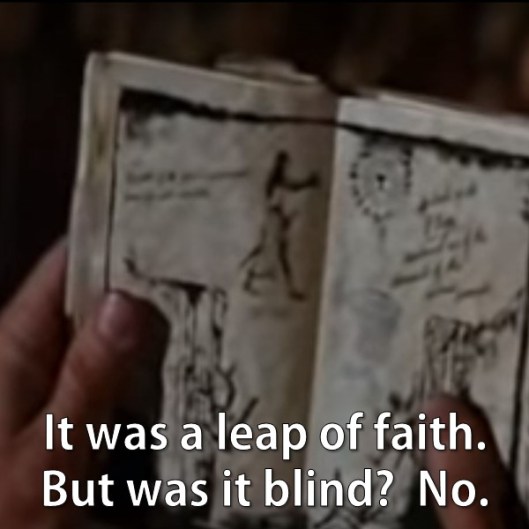
“The Leap of Faith” is the clearest example of what people may claim to be blind faith.  If you don’t remember it, watch it here (http://www.youtube.com/watch?v=xFntFdEGgws ).


But don’t miss the facts.  Indiana did not simply come upon a cavern and blindly step into it.  He had his father’s lifetime obsession and meticulous study of the history of the grail.  He had his father’s notebook with a drawing of how he should approach the cavern.  And, he had the experience that the book was trustworthy – the penitent man doesn’t get his head chopped off, and the name of God is firm.

These EVIDENCES and EXPERIENCES and the person and character of his father are what Indiana Jones had faith in.  He trusted these things, and stepped out in faith.  The path was invisible, but his faith was not “blind”.  He had reasons to believe.

Evidential Faith in the Bible

Jesus encouraged this type of faith throughout the Gospels.  And he encouraged his disciples to put their faith “in Him” and in his miracles.

“Believe me when I say that I am in the Father and the Father is in me; or at least believe on the evidence of the works themselves.” (John 14:11)

“Later Jesus appeared to the Eleven as they were eating; he rebuked them for their lack of faith and their stubborn refusal to believe those who had seen him after he had risen.” (Mark 16:14)

(He didn’t rebuke them for their stubborn refusal to believe their own eyes that saw him crucified dead and placed in a grave.  He rebuked them for not believing what they should have accepted as reliable testimony.)

“A week later his disciples were in the house again, and Thomas was with them. Though the doors were locked, Jesus came and stood among them and said, “Peace be with you!”

Then he said to Thomas, “Put your finger here; see my hands. Reach out your hand and put it into my side. Stop doubting and believe.”

Thomas said to him, “My Lord and my God!”

Then Jesus told him, “Because you have seen me, you have believed; blessed are those who have not seen and yet have believed.” (John 20:26-29)

(Again, Jesus is confirming that those who have believed based upon the reliable testimony of the other disciples even to the present day will be blessed.)

This is not BLIND faith.  Blind faith in Jesus Christ would be believing “in him” without knowing the first thing about him, any testimony about him, nothing about your need for him, what his life, death, or resurrection meant, or even how he might be relevant to your life.  That would be strange faith indeed.

It is certainly NOT what Christians mean by faith in Christ.

:DW

No Blind Faith – Part 1

07 Sunday Apr 2019

Posted by D. L. Williams in C.S. Lewis, Campus Apologetics, Church, Philosophy, Ratio Christi

≈ 2 Comments

Central Thesis:

No one can actually believe in something blindly.

What is the concept meant by the term Christian “Faith”?

“Faith is believing what you know aint so.” – Mark Twain

“Faith is believing in spite of the evidence.” – Christopher Hitchens

“Believe me when I say that I am in the Father and the Father is in me; or at least believe on the evidence of the works themselves.” – Jesus of Nazareth

“Faith is being sure of what you hope for and certain of what you do not see.” – The writer of Hebrews (Chapter 11, verse 7)

We can dispense with the incorrect characterizations of Hitchens, Dawkins, Twain, et al completely by simply pointing out that their understanding of Christian faith is incorrect.  In fact, if they were accurately describing Christian faith as “believing in spite of the evidence”, then they would also be accurate in stating that Christianity is dangerous and tantamount to child abuse.  But they do not understand what the word “faith” means in a Christian and Biblical context.  Do you?

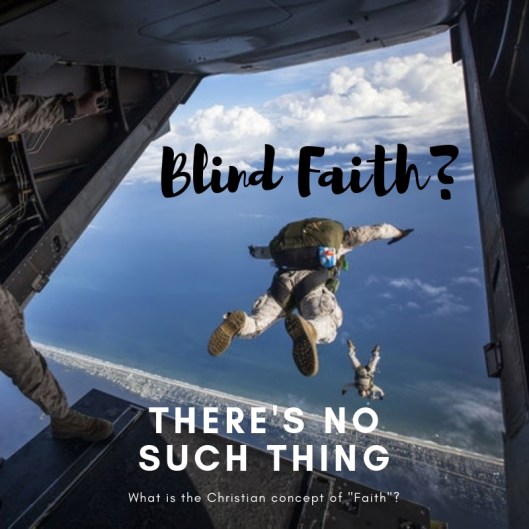
Blind_Faith_

This series of blog posts will explore what is (or at least should be) meant by Christians when they say they have “faith” in Christ.  This will serve dual purposes of causing the Christian to seriously consider HOW they themselves came to faith, and of providing a starting point for discussion with non-believers about the word “faith” in a Christian world view.

This series will explore the following:

  • Part 1 – Introduction to my “No Such Thing as Blind Faith” series of posts
  • Part 2 – What is the Biblical concept of the word “faith”?
  • How does one come to have “faith” in something?
    • Part 3 – Sources they trust – parents, pastors, professors, publications, papers, posts
    • Part 4 – Intuition – putting the pieces of life together (least “explainable” but still not “blind”)
    • Part 5 – Reaction to stress or joy – mountain tops and valleys in life
    • Part 6 – Experience – direct experience with Christ in some way
  • Part 7 – Conclusion, support of the central thesis, and how we come to change our minds

The bottom line

Many people shy away from apologetic study because the focus is on historical reliability, logical progression, reading, reading, and more reading.  They may incorrectly say, “I just believe” or even “I just have blind faith”, meaning (perhaps) that “I haven’t read all those books, but I have received comfort from Christ” (experience).  Or “I have seen Christ change my (child, father, mother, wife, husband, brother, sister), and can see that it is true” (sources). Or “I cannot explain how mankind (myself included) can be so evil without acknowledging sin, and Christ’s atonement lines up with this” (intuition). Or “I’m so wracked with grief; God help me!”  “I can’t contain my JOY! Praise God” (reaction). Or “God was there in my grief.  God was there in my joy!” (experience)  These are not as rigorously literary as a historical treatise on the evidence for the resurrection, but they are clearly not “blind“.  In one way or another, they are “evidence”.

There are separate posts on each of the above topics.  In the end, the central thesis “that there is no way to actually believe in something blindly” is strongly supported.

:DW

#WalkAway and Search for TRUTH

10 Wednesday Oct 2018

Posted by D. L. Williams in Campus Apologetics

≈ Leave a comment

Tags

#WalkAway

Being a professor means I analyze the world around me, I find thoughts and theories that align with reality, and then I profess these ideas to others to pass on the torch of knowledge.

Chemistry has been the area of reality that I have studied the most. Therefore, chemistry is the topic about which I profess the most often and in the most detail.

Christianity’s description of reality is the second-most active area of my study. I emphasize the word STUDY. I thrive on QUESTIONS.

Why God? Who’s Jesus? Why would someone think the Bible is believable? And on and on.

Lately, as I work with a student group that makes the case for the truth of Christianity, I have been studying one of the most important topics we can study.

How does someone CHANGE their mind?

In my studies of this I have been fascinated by atheists who have converted to Christianity. And, I have also been fascinated by Christians who converted to atheism.

This is why I have been lit up by the #WalkAway video movement.

thumbnail

It has only been 3 months, and there are over 100 personal videos posted on their official YouTube channel describing their #WalkAway moment where they decided to walk away from the Democrat Party or “The Left”.

I put the playlist on Play All and have been amazed at the moments when the mental switches flipped.

Here are some things I have noticed.

  1. Congratulations to anyone who has had a #WalkAway moment. You now have experienced what it is like to listen to a different channel than the default channel you grew up with.
  2. Noticing NEW FACTS is NOT voluntary. You can’t MAKE yourself believe something new or force yourself to believe something old once NEW FACTS have been truly noticed.
  3. Something about the new facts matched the world you ACTUALLY live in. You assented or ACCEPTED that these new facts are TRUE.
    1. This acceptance of new facts matching reality relieves a tremendous amount of cognitive dissonance (mental discomfort), and so an emotional rush comes from this assent. This is in nearly every #WalkAway video.
  4. Lastly, when you realize that you have accepted new facts that to the best of your understanding match REALITY, you are faced with “crossing the line” – taking action.
    1. This requires a ton of TRUST that the facts you have collected and accepted as matching reality are TRUE. Taking action on wrong facts will have negative consequences.

These three steps are present in every #WalkAway story that I have watched: 1) noticing new facts, 2) assent to their truthfulness, and 3) trusting in their truthfulness by taking ACTION.

I’ve also seen these same steps in every conversion and deconversion story.

Surprisingly, these same steps were identified 500 years ago (and probably originated earlier) using the latin words noticia, assensus, and fiducia. (Apology of the Augsberg Confession, Philip Melanchthon, 1530)

But NOW WHAT?

So you have now had a #WalkAway moment from the Left or Democrats or whoever. Great.

Here are my recommendations going forward.

  1. Noticia: Keep “noticing new facts”. Don’t let that nerve go dormant ever again.
    1. It is my view that this “waking up” to notice new facts is a soulish or spiritual activity.
    2. Noticing facts about your own failings and brokenness is actually the work of God. Jesus said this would happen in John 16 “he will convict the world concerning sin and righteousness and judgment [John 16:8 ESV]” YOU don’t wake yourself up to this fact, it is an act of God in your life. Jesus calls it “conviction”. Yes, it is uncomfortable.
  2. Assensus: When you see that these facts line up with reality, you have a choice – resistance or assent.
    1. Forcing yourself to ignore facts you believe to be true is a horrible way to live.
    2. Do your research. If you have political questions, read more about politics. (Don’t take an actor’s or newscaster’s word on politics. Duh!)
    3. If you have religious questions ASK an intellectual RELIGIOUS person. (Don’t take an actor’s or newscaster’s word on spiritual matters, especially if their only opinion is mockery. Duh!)
    4. THE BEST PLACE for you to explore the facts related to Christianity is at a Ratio Christi Chapter on a college campus near you, or at a Reasonable Faith chapter, or at a Reasons to Believe chapter, or their websites and the Stand to Reason website.
  3. Fiducia: You will know when it is time to take action. There’s always a line to cross.
    1. For #WalkAway, it was making a video.
    2. For Christianity, it is taking action by trusting that God is there through prayer, or going to a church, or being baptized as a Christian.
      These actions make no sense if noticia and assensus are absent. So don’t stress about it at this time.
      (A note about choosing a church, if the leaders of the church do not value apologetics then move on. Apologetics is ‘making a case’ for the truth of something. A church that doesn’t engage in ‘making a case’ for their view is full of synchophants who will be suspicious of anyone asking questions. Move on.)

My message to the #WalkAway movement

You are enthusiastic about searching for the TRUTH. I don’t want you to lose that spark!

Seek the truth! Always.

Jesus said, “I am the way, the truth, and the life.”

IF he was right, then a search for truth will lead you to Him.

If he was not right, then it wont. You have nothing to lose by searching.

It’s great to #WalkAway, but where are you going to WalkTo?

I love you all. If I didn’t, I wouldn’t have this page.

Darren

A Real Resurrection and Why It Matters

30 Friday Mar 2018

Posted by D. L. Williams in Campus Apologetics, Church, Historiography

≈ Leave a comment

We should tell our kids the TRUTH.

Natasha Crain’s latest post at Christian Mom Thoughts is a good one. I’ll let her set up the issue:

We attended that church for three years before we realized something wasn’t quite right. It was Easter Sunday when the pastor informed us, “It doesn’t really matter if Jesus rose from the dead or not. What matters is that he lives on in our hearts and we can now make the world a better place.”

We didn’t know the term for it at the time, but we had been attending a “progressive” Christian church. I knew the pastor was preaching something unbiblical, but I couldn’t have begun to articulate why—even though I had grown up in a Christian home and had spent hundreds of hours in church.

It’s sad to me in retrospect that the question of why it mattered that Jesus was raised from the dead was not completely clear in my mind by that point. But I think it’s a good example of how explicitly we need to connect the dots for kids. We can’t assume they will automatically deduce why the resurrection matters just because they learn the resurrection happened.

So why does it matter?

Read the rest of her excellent post here.

There are several reasons a real, bodily resurrection matters.

1. All of Christianity rests on Jesus and his death as the sole atonement for our sin.

[1Co 15:17 CSB] 17 And if Christ has not been raised, your faith is worthless; you are still in your sins.

[emphasis mine]

2. The MAJORITY of kids walk away from the faith. Why?

In almost every case it was because they have never been given ANY factual basis for belief.

They’re being talked out of their faith. Why? Because they’ve never been talked INTO it. – Frank Turek

More from Frank on the Youth Exodus Problem…

We can lay the blame for much of this on ourselves — that is, on the church. While there are notable exceptions, most American churches over-emphasize emotion and ignore the biblical commands to develop the mind (1 Pet 3:15, 2 Cor. 10:5). In other words, we’re doing a great job performing for our youth with skits, bands and videos, but a terrible job informing them with logic, truth, and a Christian worldview.

We’ve failed to recognize that what we win them with we win them to. If we win them with emotion, we win them to emotion.

3. There are two types of sharing what we would call good news.

One type of good news is SUBJECTIVE.

  • “Hey! This new workout plan works for me, and it might work for you.”
  • “Hey! I love this new restaurant, and I bet you would too.”
  • “Hey! I was hurting and this book really helped.”

This is sharing a SUBJECTIVE opinion about things we find helpful and important. It is based upon the opinion of the subject making the observation (YOU). You are assuming that others might receive the same benefit, so you share your opinion with them.

THIS was the type of evangelism training I received in multiple churches in multiple denominations. “Give your personal testimony”, they said. “No one can refute your personal story”, they said.

Looking back, I see that this was a deliberate effort to avoid having to know any disputable facts. It did not serve me well at all, and it wasn’t an effective evangelism strategy for people who had questions about the facts of the Christian truth claims.

The other type of good news is OBJECTIVE.

  • “Hey! Large doses of acetaminophen will damage the liver, so don’t give your infant an adult dose of Tylenol!”
  • “Hey! You have a broken leg, and you need a doctor. I’ll take you to mine.”
  • “Hey! Don’t step off the ledge because gravity at this height will KILL you.”

These three examples are warnings and OBJECTIVE observations. It is not my opinion that excessive doses of Tylenol will harm the liver. Anyone could repeat an assessment of the data to see what the FACT of the matter is.

How is it that I’m classifying warnings as good news? Well, if your leg is broken, it is good news for someone to point that out to you. It is even better news if they know of a doctor who can set it.

The quote from Paul captures the OBJECTIVE connection between the resurrection and “your sins”.

[1Co 15:17 CSB] 17 And if Christ has not been raised, your faith is worthless; you are still in your sins.

IF you ACTUALLY have a SIN problem, then being warned about it is an example of OBJECTIVE good news.

If Jesus ACTUALLY rose from the dead, then this has HUGE implications about who HE is and who YOU are. This has huge implications for the connection of YOU to HIM. It points out that this connection may well be the most important connection in YOUR life.

It’s worth exploring. So PLEASE explore. Start with these posts, and pull the thread for you AND for your precious kids.

  • Ken Samples: 12 Evidences for the Resurrection
  • J. Warner Wallace: Did Jesus REALLY Die on the Cross?
  • Bedrock Facts about the Resurrection
  • Historiography – How we know things in the past
  • Who is Jesus?

Aside

Easter Fools Day

27 Tuesday Mar 2018

Posted by D. L. Williams in Campus Apologetics, Historiography

≈ Leave a comment

Many of my friends have remarked that Easter falls on April Fools day, this year. Although they don’t say much, it seems like they are bracing for a bunch of jokes and snide comments about the foolishness of Christianity in general and the foolishness of believing that Jesus rose from the dead in particular.

If it were just a bunch of Aesop’s fables, Kipling tales, and folk lore, then not only would I have left the fold long ago, but I would be excited to tease the non-thinking adherents this April Fool’s Day.

I hope that shocks you. Hopefully, you think that doesn’t sound like me. It does, however, sound like the “old me” before I took my behavior seriously. I began taking my behavior seriously because I began taking my faith seriously. I began taking my faith seriously because I began to see the Christian truth claims as TRUE, not just as cultural clothing.

What led to this? Well, I found a surprising amount of historical and archeological data supporting the central claim of Christianity – that a dead guy (Jesus) came back to life.

Really?

Really.

Read my friend Ken Samples post for this evidence.

via A Dozen Evidences for the Resurrection of Jesus

Good Criticism Takes Work

06 Saturday Jan 2018

Posted by D. L. Williams in Campus Apologetics, Philosophy, Reality Blog

≈ Leave a comment

If you looked at this mess and said, “I don’t like Thomas Kinkade’s paintings” you would be revealing more about yourself than you would about Thomas Kinkade.
And yet, often critics look at the disordered bits of the Christian world view that they are vaguely familiar with, and proclaim “I don’t like Christianity”.

Again, they are unwittingly revealing more about themselves than about Christianity, because they have not done enough work to understand the thing that they are criticizing.

It take work to put together a puzzle. And it takes work to put together the pieces of someone else’s world view in your own mind. But it is critical to reserve judgment until you have understood the thing you are judging.

For puzzles, it’s easy. Look at the box.
For world views, read an apologetics book that puts the pieces together in a concise way in modern language.

I highly recommend J Warner Wallace’s Cold-Case Christianity or God’s Crime Scene or Greg Koukl’s The Story of Reality. 

Worship – within a larger context

18 Monday Dec 2017

Posted by D. L. Williams in Campus Apologetics, Church, Liturgy, Ratio Christi, Worship

≈ Leave a comment

The latest article by Rod Dreher is worth pondering. I hope you will take 15 to 30 minutes to soak it in. He is interviewed by a college student, and thus, he is forced to give a sketch of his last many years writing and wrestling with the biggest issues.

Since I have kicked the wasp nest of worship here and here, I thought I’d excerpt his thought-provoking words on worship as a teaser to the larger article. Please savor the whole thing one morning this Christmas season.

My interviewer told me that there’s a strong tendency among his Christian peers to dumb down Christian worship — to make it instantly accessible to anybody, without having to do any work. He said he struggles to understand the anti-intellectualism of all this, especially as it manifests itself among college students. What’s more, they act as if anti-intellectualism was an egalitarian virtue.

This, I responded, is exactly the wrong approach. It’s not that they ought to be making worship more complex and demanding, necessarily, but this stance assumes that we stand over worship asserting the right to mold it to fit our preferences. You end up with a ritual that worships yourself, not God, whether you mean for it to or not. Similarly, if you see the Christian tradition that way, as a repository from which you can pick and choose this or that thing, and make a bricolage of it, you may soon find that you have decorated a temple to yourself.

Powerful words. Read the whole enchilada… It’s worth it!

Love to you all!

Darren

Healing words for a sick world

01 Friday Dec 2017

Posted by D. L. Williams in Campus Apologetics, Sexual Ethics

≈ Leave a comment

Sick of hearing about the sexual [mis]conduct of nearly every famous news anchor, politician, coach, actor, producer, etc?

Me too.

Rather than rant about it, why not step back and analyze it some? Here is an excellent article from Salvo Magazine on loving relationships. -DW

(Hat-tip to Wintery Knight.)

–Begin Excerpt–

Mastering Modern Love

How Chastity Orders Your Relationships & Liberates You for Love, by Terrell Clemmons

Chastity: So Out, It’s In

The second approach is one Dawn developed following her Christian conversion, when she completely rethought how to “do” unmarried life. This approach offers modern singles like Jordana something they desperately need but may not even know exists: a sound alternative paradigm for love and sex—a lifestyle she calls singular. “To be singular is to understand the meaning of chastity, and chastity by its very nature goes against the popular culture’s beliefs regarding sex and choice.” It’s “the new counterculture . . . so out, it’s in.”

Contrary to the pervasive bad press it’s gotten from libertines, chastity isn’t about “not having sex.” In fact, it’s about a lot more than just sex. Dawn defines it beautifully: “Chastity is the virtue that enables us to love fully and completely in every relationship, in the manner that is appropriate to the relationship.” Of course, this raises the question of what determines appropriateness, but from both a scriptural and natural law standpoint, this is an easy question to answer. Sexual expression is appropriate to the marriage relationship and inappropriate to all others. Whether or not it’s easy to follow is certainly another matter, and Dawn gives excellent counsel on that and other related matters, but the point here is that the categories are discrete and clearly discernible.

The Chaste Singular

More important, chaste living is grounded in something larger and more permanent than the individual. Whereas in modern singlehood, love is based on feelings, which are apt to change with the wind or even last night’s dinner, chaste love is defined by and grounded in God himself. Love of God—love for God and love from God—becomes the love that orders all other loves. “For each of those whom divine providence places in your life,” Dawn writes, “friends, family, the stranger on the street—you ask yourself, how can I love God through loving this person?”

Whereas the modern single is driven by an inner void that is desperately trying to get filled, the chaste singular looks to God himself to fill the void. Rather than trying to get love through the right match, the chaste singular receives love from God, the ultimate source, and then turns outward with love to give from an inner fullness.

Chaste love is respectful. It behaves with appropriate decorum, which requires forethought. What is the nature of this relationship? Why am I in it? Where is it headed? What are my intentions?

—Read the whole article—

Welcome SHSU SSA Members

16 Thursday Nov 2017

Posted by D. L. Williams in Campus Apologetics, Grief, Death, and Dying, Historiography, Philosophy, Ratio Christi, Reality Blog

≈ Leave a comment

ssa-logo

I was pleased to accept an invitation to address the SHSU Secular Student Alliance at their Nov 16th meeting.

For the students who I met there, I created this landing page for you in the event that you come to my blog seeking more information about my remarks.

Since I am a full-time Chemistry professor and not a full-time blogger, my posts are few and far between. And they are not a comprehensive treatment of the Christian religion. Still, I think they are useful and encouraging or I would not have written them.

I welcome your questions about anything I have written, preferably personally. Let’s have lunch at the South Paw. I’ll buy the first one. OK?

My main remarks were on What I believe and why I believe it.

I talked about Christianity being the best description of reality – the way things REALLY are. No doubt this is a curious claim.

I discussed evidence outside of Christianity that corroborates the main points in the life of Jesus.

You may have incorrect thoughts about what the word ‘faith’ means within a Biblical framework. This series of posts at the Ratio Christi at SHSU blog should help you understand that there is No Such Thing as Blind Faith.

If I had to predict what tomorrow’s questions will be, I’d choose the following:

  1. The Problem of Evil and Suffering. (Video 1 and Video 2)
  2. Moral Issues
  3. Science Issues (The Big Bang and Fine Tuning)
  4. Philosophical Questions (Contingency and Ontology)
  5. Biblical Questions (What is the Bible? The Story in the Bible. Literary Styles in the Bible. The Bible as Meditation Literature. and The Use of Narrative Passages in the Bible.)
  6. Specific Questions about Biblical Passages (Go to the Bible Project to see an OVERVIEW OF EVERY BOOK OF THE BIBLE. Their work is masterful!)

None of this will matter if you are unable to entertain the idea that you might be wrong in your assumptions. Yes, that cuts both ways. I’m okay with that.

Are you?

God bless you for making it this far.

-DW

← Older posts
Newer posts →

Subscribe

  • Entries (RSS)
  • Comments (RSS)

Archives

  • July 2025
  • November 2024
  • September 2022
  • August 2022
  • September 2020
  • July 2020
  • February 2020
  • January 2020
  • November 2019
  • September 2019
  • August 2019
  • July 2019
  • June 2019
  • April 2019
  • February 2019
  • December 2018
  • October 2018
  • August 2018
  • April 2018
  • March 2018
  • January 2018
  • December 2017
  • November 2017
  • September 2017
  • August 2017
  • July 2017
  • May 2017
  • March 2017
  • February 2017
  • January 2017
  • December 2016
  • October 2016
  • August 2016
  • May 2016
  • April 2016
  • March 2016
  • August 2015
  • February 2015
  • September 2014
  • August 2014

Categories

  • Biography
  • C.S. Lewis
  • Campus Apologetics
  • Church
  • Education
  • Grief, Death, and Dying
  • Historiography
  • Literature
  • Liturgy
  • Philosophy
  • Podcasts
  • Prayer
  • Ratio Christi
  • Reality Blog
  • Sexual Ethics
  • Uncategorized
  • Worship

Meta

  • Create account
  • Log in

Blog at WordPress.com.

Privacy & Cookies: This site uses cookies. By continuing to use this website, you agree to their use.
To find out more, including how to control cookies, see here: Cookie Policy
  • Subscribe Subscribed
    • Apologetics4all - Dr. Williams' Religion Blog
    • Join 28 other subscribers
    • Already have a WordPress.com account? Log in now.
    • Apologetics4all - Dr. Williams' Religion Blog
    • Subscribe Subscribed
    • Sign up
    • Log in
    • Report this content
    • View site in Reader
    • Manage subscriptions
    • Collapse this bar
 

Loading Comments...