Reality Blog – Cemented Faith (Chapters 3 and 5)

7882810002_large

My sweet ride in 1984.

Regarding Stories – True or False – Fact or Fantasy

Out of school early with my own driver’s license and a car. Sure, I was headed to a doctor’s appointment for my sprained ankle, but the point was the sense of freedom I felt driving myself around. Two months of solo driving and the thrill had not worn off.

Safety was always a big deal with me. I thought of taking Long Ave, but the turn onto 199 was not a protected left. So I stayed on River Oaks Blvd. It was a big and safe intersection with two protected left turn lanes. I was in the leftmost one in the front of the line.

Green arrow, let’s go. I pulled out at a moderate pace and noticed an enormous cement truck crossing the white line in the oncoming lane. I slammed the brake pedal to the floor causing my car to quickly stop. Then, I realized that stopping wasn’t going to help. I was in his path, and he was still headed my way.

Notice, the beginning of this story.

I didn’t start it with “Once upon a time” or “A long time ago in a galaxy far, far away…”. No, I am writing this story in a deliberate manner to convey that it is a real life, true, and actual occurrence in my life. It is fact, not fantasy. It happened in November 1984. I can’t remember the exact day, but I bet my mom and dad can.

Stories can be true or false, fact or fantasy. This is an ongoing blog series on Greg Koukl’s book, “The Story of Reality”. Get the book. Begin at Part 1. And participate in the discussion by posting comments on the various posts.

When you first read Greg’s title, “The Story of Reality”, what did you think of it? Did you automatically put it in the category of fiction or fantasy? Answer below in the comments so we can discuss it. (Remember, this is asynchronous interaction, so don’t worry about being late to the party. These internet discussions do not have any preset time limit.)

Back to my 1973 Oldsmobile Cutlass Supreme.

I knew I was stopped. I knew the cement truck was not. I knew it was massive. I knew this was the end.

So I relaxed.

What? How could someone relax in a situation like that?

I simply thought, “Hey, I’m outta here. I’m dead, and now I’m free, headed heavenward. No more basketball practice with Coach John Doe*. Jesus, here I come.”

I didn’t feel anything. I’m sure I got bounced around violently. I had a rectangular knot on my forehead from the rearview mirror, and my hip bent the gearshift. But after the car stopped spinning around, I opened my eyes to smoke, steam, and a destroyed windshield. The cement truck had crushed my car from the right-front headlight to the driver’s side door.

Funny, my first thought was “Crud, I’m still here.” Even funnier was my second thought, “Hey I better get out of this wreck before it blows up.” I was imagining a Hollywood style conflagration.

The door opened and dragged against the pavement. I hobbled over to the curb to sit down. Sadness ensued as I looked at my car all destroyed and smoking. I was sparkling Edward-Cullen-style with pulverized glass from the windshield.

Hours and seventeen X-rays later it was determined that I did not have a single broken bone or laceration. To play it safe, the doctors told mom to wake me every two hours because of a possible concussion. It didn’t sink in how severe the wreck was until I overheard mom reading police reports from eyewitnesses.

The woman in a car immediately behind me said, “After the explosion, I got out of my car to pull the body from the wreckage.”

The body! She thought I was “a dead body”.

Strangely, it was then that I started crying. I sobbed. It was her perspective that alerted me to the severity of the wreck that I survived.

All because I relaxed.

What are my intentions in telling you this true story?

It is NOT to brag about strong faith. I didn’t have to exert any strength or psych up extra courage.

It is NOT to make a claim that my experience proves God is real, heaven is real, or fear of death makes one weak.

My intentions are:

  1. To get you to consider how life-changing a TRUE story can be.
  2. To illustrate how being convinced is actually effortless.

Being raised in the church (specifically Saint Andrew’s Episcopal Church in Fort Worth, TX), there were ample opportunities to “make my faith my own.” I did that in 5th grade when I read the Sermon on the Mount (Matthew 5-7), and thought to myself, “uh-oh. I don’t stack up too well. Jesus forgive me.” That conviction was a gift, and being convinced of my lack took no effort on my part. (John 16:8-11)

Life has ups and downs and so does behavior. I was not an angel. I am deeply sorry for the horrible ways I treated some of my classmates and teachers. (If you remember, please forgive me.)

Back to the cement truck story.

It is a FACT that I relaxed. It is a FACT that my first thought was one of relief when considering my eternal destiny. This TRUE story affects me even today.

I do still fear airplane crashes, head-on collisions, and other painful ways of leaving this material world behind. But I still remember the crash of 1984. It wasn’t painful. It wasn’t scary. It was in FACT a hopeful experience.

What kind of God gives REAL peace? A REAL God?

[John 14:27 HCSB] 27 “Peace I leave with you. My peace I give to you. I do not give to you as the world gives. Your heart must not be troubled or fearful.”

Could it be that a REAL God exists? Could it be that Jesus was unique in all of history, and that his claims were TRUE?

A REAL God requires a TRUE story.

Greg is telling that TRUE story in his book.

I hope you will read it, discuss it, and be transformed by its message.

-Darren


*I changed the name so as to not hurt the actual coach.

<<Previous Post | Next Post >>

Reality Blog – The Puzzle – Chapter 2

This is an online blog of Greg Koukl’s book, The Story of Reality. It should be taken as an online book club discussion. So, get your copy, start at the beginning.  and contribute in the comments section. Subscribe for updates so you’ll know when the next post appears.

I’m trying today’s post from the phone app, so forgive any thumb-induced typos.

Puzzle

We just received a puzzle as a gift for Christmas from our neighbors. We enjoy them as a family but they take time and commitment. Especially a 1000 piece puzzle like this one.

You have to set aside a space for the puzzle. We use a card table.

You need good lighting.

We use puzzles as a social time where many eyes can look through the pieces and discuss where we think they fit best. (Protip: puzzles are one of the few remaining screen-free family activities. And often deep conversations ensue.)

Greg’s example of the worldview puzzle fits nicely into this scheme.

Space. When analyzing your own worldview, you must think about how you think. (This is meta cognition, and is one unique aspect of humanity.) Thinking about thinking requires mental space and space in your schedule. It is my hope that you will set aside some space every day or week to study your worldview. That is why I’m doing this blog series. I’m clearing some space in my calendar to encourage you to clear some space in yours. I trust Greg, so I figured his book would be a good place for you to start if you have never thought much about these things.

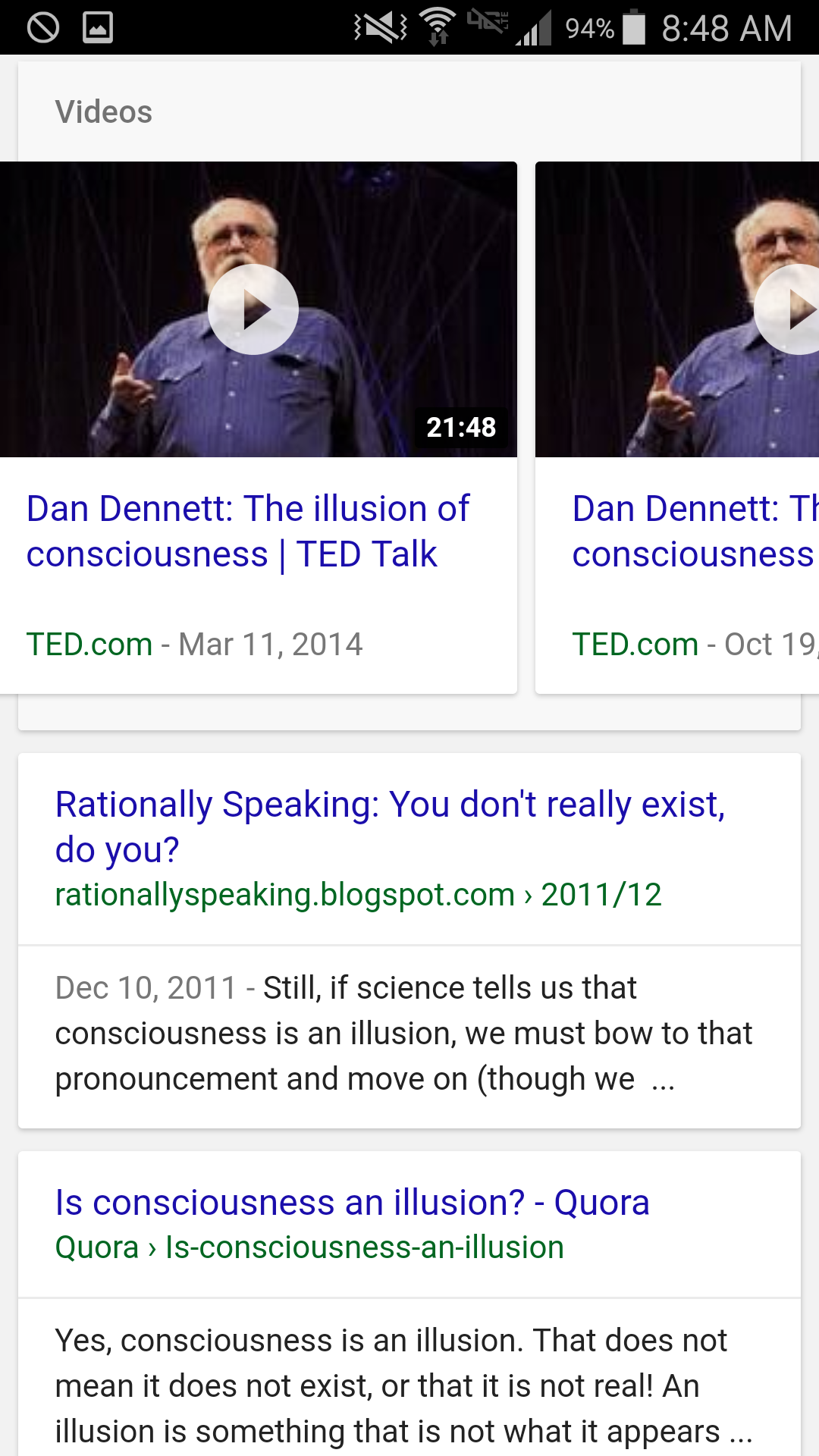
Lighting. In my puzzle scheme, what does good lighting look like? When thinking about thinking, good lighting is a commitment to the TRUTH. You don’t want to have to force pieces together, nor do you want a distorted view of reality. Take for example the many vocal and (partially) logically-consistent atheists who take atheism to its logical conclusion that consciousness is an illusion. They are very persuasive. I mean, they’ve given TED talks so they must be right. Right?

This is the opposite of light. They are telling you that you get to make up your own picture on the front of your own puzzle box. The Bible speaks about this most clearly in Paul’s letter to the Romans.

For though they knew God, they did not glorify Him as God or show gratitude. Instead, their thinking became nonsense, and their senseless minds were darkened. Claiming to be wise, they became fools.

I want to focus on the foolishness of claiming that consciousness is an illusion. Is Daniel Dennett conscious of his illusive consciousness? What light is illuminating his worldview puzzle? And without consciousness, it is foolish to talk of science or facts. The world is unknowable because there is no “knowing”. Foolish, indeed.

(Caveat. I’m not using ridicule as an argument against Dennett. I am pointing out that using consciousness to argue against consciousness is self-refuting folly.)

Social Time. Lastly, there is a social aspect to this puzzling about worldview puzzles. I’m attempting to create some social interaction on the topic through this blog for those who are geographically isolated like I am. But if you get a chance look for a Ratio Christi chapter if you are near a college campus, or a Reasonable Faith chapter, or a Reasons to Believe chapter in your town. These are awesome places with friendly puzzlers who would love to discuss the search for truth with you.

Let me know if you are plugged into one of these groups, and what you think of them in the comments section.

<<Previous Post | Next Post >>

Reality Blog – Preface and Chapter 1

This is an online book club discussion of Greg Koukl’s latest book “The Story of Reality: How the world began, how it ends, and everything important that happens in between.”

Start at the beginning to catch up.

Preface

“There are reasons for the way things are.”

We know this, which is why we ask “why”.

“As we get older, asking “Why?” goes deeper into the heart of things. We begin asking the question not of any individual think, but of the whole thing. What is the reason for everything? Why am I here? Why is anything here? Why is anything important or good or beautiful? Why?”, p. 17

Or as we have recently lost a dear family member, we ask “Why was his life cut short?”

The nihilist* says that there is no “real” purpose, and the answer to the “why question” is “why not?” A popular book by John Green The Fault in Our Stars gives a nihilist perspective throughout. The youth in his story are dying of cancer and try to reject nihilism by making up their own purpose for life, which consists of close friendships and cathartic emotional release. If you saw the movie, they are left with merely being “OK” with it all. If you’ve read Green’s book, you’ll enjoy this.

*Definition of nihilism: 1.a: a viewpoint that traditional values and beliefs are unfounded and that existence is senseless and useless – “Nihilism.” Merriam-Webster.com. Merriam-Webster, n.d. Web. 21 Dec. 2016.

Chapter 1 – Confusion

Is Christianity any better? Is nihilism the truth and religion merely a very elaborate plan to deceive ourselves with a made-up purpose? Greg outlines this modern (but false) approach to religion on page 22.

“Find the club you like – the one that meets your personal needs, that gives you rules to live by that are respectable but not too demanding, that warms your heart with a feeling of spirituality. That’s the point of religion. Do not, however, confuse religious stories with reality. They don’t give you that kind of information about the world that, say, science does. Yes, believing in God is useful to a point, but religion taken too seriously is, in some ways, like believing in Santa Claus – quaint if you’re a child but unbecoming of an adult.” p. 22

This view is essentially Marx’s dictum that “religion is the opiate of the people”. It is very common even if not stated explicitly by neighbors and colleagues. And it is stated explicitly by many debaters and authors. For example, Philip Kitcher writes in Living with Darwin,

“There is truth in Marx’s dictum that religion, more precisely supernaturalist and providentialist religion, is the opium of the people, but the consumption should be seen as medical rather than recreational. The most ardent apostles of science and reason recommend immediate withdrawal of the drug – but they do not acknowledge the pain that would be left unpalliated, pain too intense for their stark atheism to be a viable solution.” (Kindle Location 1626 of 1862), OUP 2007.

Kitcher wants religion to flourish as a community-building useful fiction, but he wants to rid it of any claim to reality.

Greg disagrees, and in his book, makes the bold claim that,

“Christianity is a picture of reality.”, p. 23

Christianity is an all-encompassing worldview among many others. And in this book Greg is walking us through the process of evaluating how the “many puzzle pieces of life” fit together if Christianity is the “picture on the front of the puzzle box”. Likewise, fewer of life’s puzzle pieces fit together if a different worldview is used as the picture on the front of the box. That’s where we are headed in Chapter 2. Next time.

Give me your thoughts in the comments. Buy your copy of Greg’s book so we can have substantive discussions. (Again, I get nothing from his book sales.) And if I get behind, start your own blog post on the topic so we can get into dialog. It’s easy. – DLW

<<Previous Post | Next Post >>

Live-blog of the Story of Reality

I just received the much anticipated book by Greg Koukl – “The Story of Reality: How the world began, how it ends, and everything important that happens in between“.

Why would I be so excited?

  1. His book “Tactics” actually taught me how to listen to others when they are speaking. Before Greg’s influence, I spent that precious time formulating my next point instead of hearing what the person is actually saying.
  2. His podcasts have served a mentoring role for me for about 4 years.
  3. His team at Stand to Reason has informed me with their articles, talks, videos, and other resources.

Therefore, I am eager to read through Greg’s magnum opus (to use his phrase). I caught a glimpse of his view of the big picture in his DVD series “The Bible Fast Forward“. The title implies a quick treatment, but not so. This was a comprehensive treatment with a huge pdf outline.

What is a “live blog” of a book?

Well, I have heard of people participating in book clubs where several readers of the same book get together to discuss a chapter at a time. Either, my town is too small, or we are all too busy to do such an enjoyable thing, or I simply have not located enough like-interested individuals in my vicinity to form such a group. So I’ll do my part on the Internet. And if you get your copy of Koukl’s book, you can chime in at your leisure in the comments section.

We can form our own book club.

Although I may put some quotes in my blog, I will not reproduce the whole thing here. That would be illegal and worse, would harm Greg by stealing his labor. You will not be able to skip reading it for yourself, so go ahead and buy your own copy. It will make our shared experience better and our discussion deeper. (BTW, I am not benefiting from the sale of his books.)

One last caveat on time. We are entering the Christmas season, and I have a huge vista of time ahead. But that does not mean that I will spend all of it reading a book or blogging. So cut me some slack if these posts are sporadic. If you get ahead of me in the reading, then open up your own WordPress page and blog the chapters on your site. I’ll check them out when I find time and then we will really be in DIALOG. That would be GREAT!

Lastly, I probably only have an hour to devote to this, and today’s hour is up. If this interests you at all, please say so in the comments and subscribe to this blog so you will receive a notification when I post my comments on the Preface and on Chapter 1 – Confusion. (Tomorrow, Lord willing…) For now, how about a teaser quote from the Preface:

“As we get older, asking “Why?” goes deeper into the heart of things. We begin asking the question not of any individual thing, but of the whole thing. What is the reason for everything? Why am I here? Why is anything here? Why is anything important or good or beautiful? Why?” – Greg Koukl, The Story of Reality, p17

Next Post >>

TFiOS – Over Analysis

Continued from Part 1 and Part 2.

The Van Houten Archtype, “You can end this silly little blog exercise and leave this good book alone. It’s JUST a love story!”

Jim said to Kathy, “Before I finish my comments on TFIOS by addressing the likely objections of the Van Houtens out there. Since addressing objections can be dry and uninteresting, let us keep the form of a dialog. Can you play the role of a Peter Van Houten, Kathy?”

“Absolutely! I’ll just pretend I am my secular humanist History teacher, Dr. Spitz.”

“Brilliant.”

“Kathy began with a bit of faux accent, “Are not you embarrassed to be spending your precious minutes over analyzing a teen-literature book that is merely a coming-of-age love story, Mr. Jim?”

“Is teen love really the full extent of the story?”, asked Jim.

“Well, yes. Of course, the magnitude of love’s triumph is multiplied by the depth of their despair. The end of Act I in any love story is always hopeless, but it is absurd to waste your time parsing the dark nuances of the initial scenes.”

“But Peter (Van Houten), why do you think the author chose pointless oblivion, pain that demands to be felt, and a hopelessly defective set of mutant humans from the gene pool?”, asked Jim using quoted descriptions from the book.

“Well, this is the curious thing. I can’t answer for John Green – the author of TFIOS, but I would put those things in ANY book because they are true.”, said Kathy as Peter.

“How can you be so sure? Those are philosophical assumptions, not just dark circumstances tailored to make love shine brighter.”

“Well, I don’t actually think they are dark or bleak. They just are. As I taught Hazel Grace through my book An Imperial Affliction,

“All will be forgotten and this will have been for naught. And if the inevitability of human oblivion worries you, I encourage you to ignore it. God knows that’s what everyone else does.”

“So life is not dark?”, Jim challenged.

Kathy stuck out her chin in defiance, “No.”

“You are not worried about oblivion?”

“No.”

“Then, why are you a drunk?”

This shocked Kathy out of character for a second. Then she thought about how the Peter Van Houten’s out there would respond.

She countered, “Whoa! That’s none of your business! But I assure you it is NOT a philosophical issue.”

“Really. By the way, Kathy, you are doing great.”, encouraged Jim.

Kathy grinned, “Thanks.”

Jim resumed, “Let’s assume you drink too much for one or more of the many reasons mentioned in TFIOS, namely:

  • You lost your daughter to cancer.
  • You lost a loved one due to your own failings.
  • You are spoiled rich and have no sense of meaning in your life.
  • You crave the euphoria and numbness that results from drink, drugs, and sex.

Please, be brutally honest since we are role playing and haven’t got time to wade through evasions and excuses.”

Kathy paused to think. Then continued, “Well, you missed a few reasons, but some of those apply to why I am a drunk.”

“These and all other reasons are philosophical and ultimately theological.”, claimed Jim.

Playing a drunken Van Houten type as strongly as she can, Kathy yelled, “No, no, NO! We have no reason to bring GOD into this! And TFIOS is JUST A LOVE STORY! Why are you so stupid as to think this has anything to do with ME, how I choose to live my life, or especially God. He doesn’t exist, and if he did, he has ignored us to death. The God concept is irrelevant.”

“Hey, you brought God into this with Hazel Grace’s quote.”

“What?”

Jim mocked the faux Dutch accent of a Van Houten elite, “And if the inevitability of human oblivion worries you, I encourage you to ignore it. God knows that’s what everyone else does.

Smiling, Kathy countered, “That is merely a figure of speech. A literary device used for effect.”

“But God DOES know ‘that’s what everyone does.’ God constantly calls us, and we have to force ourselves to ignore His call.”

Kathy as Peter quipped, “God must not have my phone number.”

“Oh, really? Why do you crave a point to life? RRRING. Why do you sympathize with Isaac’s outrage at Monica’s betrayal of ‘always’? RRRING. Isaac knows like YOU do that love should be REAL and promises should be kept. RRRING. Knowing you are mortal, why do you long for relationships that last more than a lifetime? RRRING. You are a spoiled rich adult brat who craves ‘a point’ and ‘a meaning’ to life. Who told your heart about life having a meaning and a purpose if it wasn’t God? RRRING.

You have heard God’s call your whole life and have learned to ignore it, rage against it, overwhelm it with unintelligible Swedish hip-hop, or drown it in a glass of Scotch with imaginary water.”

Feigning a defeated frustration and annoyance, Kathy asked, “Are you finished?”

“Absolutely. All I had to do was to get you to notice God’s call, again. It is up to you whether you pick up the phone in prayer, or not. Oh, there is one more point to be made, that you might find humorous.”

“What’s that?”

“Life actually is JUST A LOVE STORY. The world is not a wish-granting factory, not a stage, not a sound and fury signifying nothing, but rather a very very long love story. It is written in the stars, in your DNA, in your relationships with others, and ultimately in your relationship with The Word.”

“…since what can be known about God is evident among you, because God has shown it to you. For His invisible attributes, that is, His eternal power and divine nature, have been clearly seen since the creation of the world, being understood through what He has made. As a result, you are without excuse. … 25 Don’t exchange the truth of God for a lie, and worship and serve something created instead of the Creator” [Romans 1:19, 20, 25 para]

Kathy as Kathy said, “Nice.”

Jim chuckled, “You think the Van Houten’s out there will buy it?”

“They will probably never read it. But if they did, maybe the RRRING will be a stone in their shoe. I hope it irritates them until they answer the call.”


*John Green, The Fault in Our Stars, Dutton Books, New York, NY, 2012.

TFiOS – Support Group

This is Part II of a series, see part I. This conversation will contain spoilers.  If that bothers you, then go read the book first.  In fact, if you haven’t read the book, this conversation will make no sense at all.

Kathy said, “I felt SOO uncomfortable reading about the Support Group! It was physically painful to experience Hazel Grace’s time in the “Literal Heart of Jesus”. Sadness was perhaps the dominant feeling. Patrick and some of the others like Lida seemed so triumphant while the rest struggled with the long march to the bottom of Patrick’s closing prayer list of the dead.”

“I had a similar feeling about Support Group. Is the Christian response to pain, suffering, illness, and terminal cancer a farce? Did Patrick portray it well?” asked Jim.

“How would I know? I’m only 15! Sheesh. What a question! I LOVE praise songs and have had great experiences singing them with my friends. But to Hazel, Gus, and Isaac, the song-playing Christian seemed repulsive. I am also bugged, now, by all the Facebook posts promising FALSLY that “God will never give you more than you can handle.””, Kathy said.

Jim replied, “Yeah, Hebrews Chapter 11 tells a different story of believers being sawn in two. I also cringe at those types of Facebook responses to suffering. They are a holy paraphrase of “Suck it up, loser!”. I’m a gamer, and given the choice between Patrick’s guitar and Cave Johnson’s Rant, I feel more connection with Cave Johnson.”

Kathy laughed, “Well, I’m not much of a gamer, but I see your point. Thank God, those are not our only two choices! When I’m hurting, I want to be with you, dad, or with mom, or my friends. I don’t want you to SAY anything, but I want you there. I want to be in that “third place” that Hazel and Gus share on the phone and that Gus and Isaac share in Counterinsurgence 2.”

“Or listening to your version of Hectic Glow?”

“Yes.”

Jim continued, “Well my Hectic Glow is currently Faure’s Requiem. THAT is no snappy, happy song played with three chords on a guitar! Faure puts forth a better Christian response to suffering, pain, and death than Van Houten’s nihilistic baseline of pointless molecular shufflings. It is in Latin, but that may actually help.”

According to Van Houten, “Who the hell speaks Sweedish? [or Latin] The important thing is not whatever nonsense the voices are saying, but what the voices are feeling.”

“Classic existentialism, according to my teacher.”, said Kathy.

“Good. My tax dollars are being put to good use. And yes, the feeling of Faure’s music may be enough to comfort those in pain. But the words are priceless as well. Why stop at existential feelings when you can have the feeling AND the meaning combined?”

Requiem aeternam dona eis Domine (Rest eternal give them, Lord,)
et lux perpetua luceat eis. (and let light always shine on them.)
Te decet hymnus, Deus in Sion (It is right to hymn you, God, in Sion)
et tibi reddetur votum in Jerusalem. (and to you will be made a vow in Jerusalem.)
Exaudi orationem meam, ad te omnis caro veniet. (Hear my prayer, to you all flesh will come.)
[Greek] Kyrie eleison, Christe eleison, Kyrie eleison. (Lord have mercy, Christ have mercy, Lord have mercy.)

Jim continued, “Although this is based on the Catholic Mass for the Dead, I have found the prayer for mercy to be a universally-appropriate prayer, and one that brought great comfort in NICU.”

Kathy challenged, “Do you think people will believe that prayer helps? It can seem like self-deception to the skeptical.”

“I acknowledge that. But you wanted a “third place” like Hazel Grace. Prayer is my third place and it is not human-based. I don’t have to feel like a burden on someone, nor do I have to wait for them to return my call. I’ll have to leave it there. If you want to read a raw evaluation of prayer, I recommend Phillip Yancey.”

““He has saved your lives so many times, and you never even knew he was there. I know him. I love him. Pass it on.”, said Martha Jones.
“Is that your weapon? Prayer!”, scoffed the Master.
And the rest is history. [well sort of]”, quoted Kathy.

“There you go quoting Dr. Who, again.”, laughed Jim, “But, let me quote Yancey.”

“Every day my vision clouds over so that I perceive nothing but a world of matter. It requires a daily act of will to remember what Paul told the sophisticated crowd in Athens: “God is not far from each one of us. For in him we live and move and have our being.” For this reason prayer may seem strange, even embarrassing. (How odd, that prayer seems foolish to some people who base their lives on media trends, superstition, instinct, hormones, social propriety, or even astrology.)”, quoted Jim.

“Ha! The Fault in Our Stars!” cried Kathy.

“Indeed”, grinned Jim.

Read Part 3.


*John Green, The Fault in Our Stars, Dutton Books, New York, NY, 2012.
Republished from the Ratio Christi Blog with permission.


Double Bounce

Adrenaline rushed as I peered straight down past my socked feet at the trampoline far below. I told him I did not want to be double-bounced, but ignoring my pleas he placed all his weight on his size 13 foot and stretched the canvas taut. There’s no stopping physics, I thought.

This week, the double-bounce came to mind in the most unexpected way. You see, we have spent 191 days praying for, rooting for, and grieving for Kenneth Brown – my brother-in-law – who was taken from us recently by brain cancer. Ken was 61. He went before us and he went too soon.

We all grieve for different reasons because our connections to Ken are different. However, one common trait will be missed by all – his encouragement. If you had the privilege of reading posts on the Rallyhood site that Patti established, you have seen that he encouraged everyone, not just his brother-in-law.

I grieve also because I have no answers to the why questions.

I’m a professor and a Christian Apologist with Ratio Christi. I’m supposed to have answers. I don’t.

But I do have some “what ifs…

What if there were really two problems with death and suffering? What if we were able to separate the logical from the emotional?

We might be able to accept the logical probability that God would have morally sufficient reasons for his inscrutable will. Just as the new mother has morally sufficient reasons to allow sweet nurses in cartoony scrubs to jab three long needles into her 1-month-old newborn baby in order to protect that baby from hepatitis, pertussis, polio, pneumococcus, rotavirus, diphtheria, and tetanus. The cold and calculating logic of the mom, the nurses, and the doctor is inscrutable to the newborn.

The newborn is seeing mom, sweet nurses, and a brightly colored room. Then POW in both thighs, and POW again in one thigh. Ow, ow, OWWW! This sensation has NEVER been felt before. What has happened? WHAT has happened! Why am I hurting?

There are no answers to the infant’s emotional and physical pain. Only the comfort of loved ones over time will help.

As I consider my own thoughts on the loss of Ken, I am hesitant. I despise answers that do more harm than good. I don’t want to give thoughtlessly chosen Bible verses, that treat internal bleeding with a Band Aid. Rather, I am digging deeply for my own sake, hoping what helps me will help others.

We want our lives to be significant. As followers of Christ, we want God to use us to His glory by empowering us to love our neighbors as ourselves. We want God to use our lives to impact others.

There is evidence from the Rallyhood that God DID use Ken’s life to impact others. There’s evidence from my family, my high school days, college days, and the many days afterward that God has used Patti’s life to beautifully impact others. Even I have been told by some students that God has used me in their lives. So, mission accomplished. Right?

Not so fast.

We had such great plans. A few years ago, Patti had chosen to give back to the future generation of business students by teaching accounting at The University. Just last year, Ken joined her and taught at UT for the full academic year. It was time to pour his international tax and business strategy knowledge into the next generation. What a God-glorifying thing to do, to step down from a long career with EY to teach.

The reason a double-bounce is so frightful is because the trampoline canvas is pre-stretched by someone much heavier than you. When you land, they release their weight, and the springs shoot you up much higher than you could ever go with just your own weight. You feel the intense pressure on your legs as you began to rocket upwards. Your hang time is epic and this gives you your first hint of excitement. The view from the high point is only available because of the double-bounce, and it blossoms into a full-blown thrill.

What if…

It is clear from the Bible that Jesus wants to use our LIVES to serve others. “Whatever you did for one of the least of these brothers of Mine, you did for Me.”, Jesus said. And in addition to loving God, he says we should, “Love our neighbors as ourselves.” (Mat 25:32, 22:39) But what if he wants also to use our death?

It is the most painful question that can be asked. But it is a valid “what if”.

Lazarus (Jn 11:1ff), the widow’s son at Nain (Lu 7:11ff), Stephen (Acts 22:20), and Jesus himself (Rom 10:6-9) had meaningful deaths in addition to meaningful lives.

It appears to have been just as painful then as it is now. Many wept over their deaths, and even Jesus cried out for another way. He knew his death was required. He BEGGED for another way. Mat 26:36-44)

And just like us, he was told, “No” through silence.

What if, like the double-bounce, Ken stretched the canvas tight by going first. What if the weight of his influence and his POTENTIAL to impact the lives of future students and others is now placed in the canvas waiting for us to land?

  • Will we feel the rush of purpose that he gives us as we launch out of this pit that we are in?
  • Will we have a longer hang-time and a greater influence as we carry his encouragement skills with us?
  • Will the height that we achieve, launched so frightfully by his death, give us a higher perspective than our own weight would have given?

I think so.

Let us comfort each other as we experience the intense pressure of grief.

And let us encourage each other as we launch higher than we thought possible.

By God’s grace,

Darren

For those visual persons here is a Video Version of this Blog Post.

My summary thoughts on Ken’s passing: Time, Distance, Shielding

Miscellany

Trampoline Tricks: https://youtu.be/XG9tjRNvd0s (< an amazing athlete)

Double Bouncing: https://youtu.be/C75Uk4F5OyU?t=3m9s (< Image credit)

Cold-Case Christianity for Kids (Review)

I remember well when Cold-Case Christianity was first published. I snatched it up, and immediately decided that this was one book that would resonate with the people in Huntsville, TX.

We house the state headquarters for the Texas Department of Criminal Justice and we have seven state prisons in the Huntsville area. What does this mean?

  • For one thing, we are a general population that values the rule of law and the evaluation of evidence in the court of law.
  • This also means that J. Warner Wallace speaks our language.

Therefore, the campus club that I lead (Ratio Christi at SHSU) decided to go through Cold-Case Christianity as a book study and to invite J. Warner Wallace to campus to present a community-wide talk on the material from his book.

It was one of our most successful events ever!

Fast-forward to today. A new Cold-case book has been released, and this one has transformed Wallace’s original Cold-Case book into a smaller package designed for kids in the late elementary and middle school range.

I pre-ordered it so that I could receive an early copy. I wanted to see how he adjusted his arguments to be within a younger person’s reach. Here is my Amazon Affiliate’s Link: Cold-Case Christianity for Kids: Investigate Jesus with a Real Detective. You can also find it available on Wallace’s blog and web site Cold-Case Christianity.

(Incidentally, Wallace has some of the best apologetics posts on the web because he is so thorough with his research. I don’t get paid to say these things. It’s just that I use his material in Ratio Christi all the time because it is so good.)

Now for the Review

The book came in the mail, and as usual my son Thomas pounced on the box to see what was in it. Cool! was the immediate response. Thomas is 14 and this review consists of his comments to me about what he read. It took him a couple of days to read, which is about 4 hours total because he “powered through it” to use his terms.

Thomas’s comments after reading through Cold-Case Christianity for Kids.

  1. The graphics were good, helpful, and well-done.
  2. All the captions from the figures are quotes from the text – emphasizing the main points.
  3. The logical arguments were presented in a way that ANYONE would understand them.
  4. The book used real-world examples, which helped.
  5. There are some fill-in-the-blank portions for kids to write in answers from their reading.
  6. We make conclusions everyday using logic. This book uses this same logic to show that God is the most reasonable conclusion to a) a universe that began to exist, b) a finely-tuned universe, c) big moral truths, and d) information in DNA. (page 50).
  7. It was a nice read.
  8. It will entertain kids, but it would be best if an adult read it with them.

As a parent, I was very pleased that this book sparked some good conversations. But this happens a lot in our house with my involvement with Ratio Christi.

But if conversations on the truthfulness of Christianity are rare in your house, get this book.

Read through it with your kids. It will start your whole family on the path to exploring God with your mind as well as your heart.

Do not be conformed to this age, but be transformed by the renewing of your mind, so that you may discern what is the good, pleasing, and perfect will of God.  [Romans 12:2 HCSB]

Topic List for Fall 2016

Ratio Christi at SHSU – Fall 2016 Topics

  • A survey of Dr. William Lane Craig’s Defenders Class on Christian Doctrine
  • Answering genuine questions from non-Christian authors and debaters
  • Meeting Fridays at Noon in LSC 319 (<room change!) on the Sam Houston State University Campus. Bring your own lunch and feed your mind.
Date Topic
26-Aug “Why study Christian Doctrine in and apologetics club?”
Matthew 28 – the Great Commission
2-Sep “Did God really say…?”
Doctrine of Revelation (General, Special, Inspiration, Inerrancy, Canonicity)
9-Sep “The Heavens declare God’s glory!”
Natural Theology (Arguments for God’s Existence, in light of General Revelation)
16-Sep “Who created God?”, asked Dawkins
Doctrine of God (Self-existent, Omnipresent, Omniscient, Omnipotent, Holy)
23-Sep “Are Christians polytheistic?”
Doctrine of the Trinity (Biblical support, Historical Survey, Arianism and Nicaea)
30-Sep “Who do they say that I am?”, asked Jesus
Doctrine of Christ (Deity and Humanity, Incarnation, Atonement, and Salvation)
7-Oct “How can you be so SURE?”
Doctrine of the Holy Spirit (Inner testimony, Presence, and Baptism)
14-Oct “From nothing, nothing comes”
Doctrine of Creation (ex nihilo, Genesis, Time, Miracles, and Angelic Beings)
21-Oct “Is the church anti-science?”
Discussion on Creation and Evolution (Views on Genesis)
28-Oct “A man is a dog is a rat is a boy.”, PETA
This week is in LSC 308 – Doctrine of Man (Image of God, the Soul, the Fall)
4-Nov “Saved from WHAT?”
Doctrine of Salvation (Calvinism and Arminianism, Justification, Sanctification)
11-Nov “Why are they all hypocrites?”
Doctrine of the Church (Baptism, Lord’s Supper, and Sacraments)
15-Nov “I Don’t Have Enough Faith to be an Atheist”
TUESDAY at 6 PM in the LSC Theater with Dr. Frank Turek
18-Nov “Why does God not stop Evil?”
Doctrine of the Last Things (Views on John’s Revelation and the Second Coming)
25-Nov Thanksgiving Break
2-Dec “What have you learned? What would you like to pass on to others?”
Wrap Up and Social Time

If you miss a meeting, or if you are not associated with Sam Houston State University, you can find outlines, transcripts, and podcasts on every one of these topics on the Reasonable Faith web site – Defenders Class Podcasts Page.

This post was originally posted at Ratio Christi at SHSU’s blog page.

The Fault in Our Stars – A Conversation

Tags

, , ,

This conversation will contain spoilers.  If that bothers you, then go read the book first.  In fact, if you haven’t read the book, this conversation will make no sense at all.

The Scenario

Kathy read The Fault in Our Stars in her 8th grade Language Arts class.  The teacher and the class loved to discuss the issues raised in the book.  When the movie appeared in theaters she regaled her father Jim with stories of her friends taking boxes of Kleenex to the show.

He asked, “Is it THAT sad?”

Kathy replied, “Oh, yes!  It is about cancer and everybody dies.  It is a love story.  My whole class loved the book!”

“You’re kidding.  It sounds literally tragic, Shakespearean, in fact.”

“How’d you guess?  The title is a quote from Shakespeare.”

“Is it the star-crossed lovers Romeo and Juliet?”

“A pair of star-cross’d lovers take their life;
Whose misadventured piteous overthrows
Do with their death bury their parents’ strife.”

–Act 1, Prologue, Romeo and Juliet

Kathy, “No.”

“This is the excellent foppery of the world, that,
when we are sick in fortune,–often the surfeit
of our own behavior,–we make guilty of our
disasters the sun, the moon, and the stars: as
if we were villains by necessity; fools by
heavenly compulsion; knaves, thieves, and
treachers, by spherical predominance;”

–Act 1, Scene 2, King Lear

Kathy grinned, “No.  But close.”

Jim clapped, “Ah, you said it was a love story!”

“That I should love a bright particular star
And think to wed it, he is so above me:
In his bright radiance and collateral light
Must I be comforted, not in his sphere.”

–Act 1, Scene 1, All’s Well That Ends Well

“Love and Death in the opening scene!”, cheered Jim.

“Here, just read the book for Pete’s sake.”, groaned Kathy.

————–<two days pass>————–

Jim commented, “Good book!”

Kathy replied, “I was worried you wouldn’t like it.  Honest!  Did you cry?”

“No comment.”

“You cried.  What part got you the most?”

“I don’t know.  What part got you the most?

“You first.”

“No, you read the book first, so you go first.”

“That’s a lame reason.  But, I’ll go first, anyway.”, said Kathy.

<As with real conversations and TV episodes, rarely do you get the whole experience in one setting.  Also, the author of this fictional conversation has a real job and a time-consuming schedule.  He will pick up where he left off next time.  Read Part II.>

*John Green, The Fault in Our Stars, Dutton Books, New York, NY, 2012.
Republished from the Ratio Christi Blog with permission.