No Blind Faith – Part 3

Moved to Faith by Reliable Sources

In support of the Central Thesis:

No one can actually believe in something blindly.

What do you consider a reliable source of information?  We put our trust (faith) in others all the time.  Eating at a restaurant shows our faith in the cooks, the health inspectors, or even the friend who tell us, “It looks terrible, but try it!  You’ll love it!”

Faith is evidenced by action.  We depend upon reliable sources to bring us to the point of taking an action like actually putting some disgusting looking food in our mouths.  There is a difference between acknowledging that your friend survived eating at a nasty-looking restaurant, and actually eating the food yourself.

Faith is NOT magic.  It does not “make something true.”  Nasty-looking (and clean-looking) restaurants can make you very sick even if you REALLY believe they won’t.  But your actions are evidence of your faith and what you trust.

In the same way, faith by itself, if it is not accompanied by action, is dead.  (James, Chapter 2, Verse 17)

Being a chemist, I am bothered by those who mistakenly claim that science is devoid of faith.  Let me speak to the scientist.  An honest scientist realizes that testing a theory requires a quantity of faith.  You are expending time, precious days of your life, and often other people’s money and time to see if a theory holds or fails in a controlled set of circumstances.  You are “sure of what you hope for and certain of what you do not see”.  But, notice the subtlety.  You are not sure of the result or certain of the result, but rather, you are sure that nature is repeatable, logical, and knowable.  How did you come to trust in the stability, the logic, and the “knowability” of nature?  Reliable Sources.

A scientist comes to know about the behavior of nature through reliable sources.  For me, it began with parents explaining the seasons, teachers suggesting books to read, and the books themselves.  I didn’t just learn facts.  I came to trust the philosophy that nature was knowable and that rational thought was trustworthy. This is not an empirical result.  It is a secondary conclusion and the foundation of empiricism.

Hence the flawed logic of scientism’s claim,

If it cannot be empirically proven, then it cannot be objectively true.

That claim cannot be empirically proven, so that claim commits suicide.

This example is not a straw man, either.  Here is the claim written in a more popular form,

It must be possible to conceive of evidence that would prove a claim false.

This is most certainly a claim that is non-falsifiable.  Further, in the same article the statement is made:

Any claim that could not be falsified would be devoid of any propositional content; that is, it would not be making a factual assertion — it would instead be making an emotive statement, a declaration of the way the claimant feels about the world. Nonfalsifiable claims do communicate information, but what they describe is the claimant’s value orientation. They communicate nothing whatsoever of a factual nature, and hence are neither true nor false. Nonfalsifiable statements are propositionally vacuous.

Therefore, “It must be possible to conceive of evidence that would prove the claim false” is propositionally vacuous.

If that makes your head explode, good. You should realize that science rests on top of philosophy.  Why do we trust our 5 senses?  Philosophy.  Where does logical experimentation originate?  Philosophy.  And it is philosophy that tells us what is logical, what is reasonable, and what sources (including empirical results) are likely to be trustworthy.

reliable-sources

Back to the question.  We use reliable sources to bring us to the point of taking action on our beliefs (faith).  We may not have studied philosophy in school, but we learned it in the school of hard knocks.  Who hasn’t felt the pain of betrayal and learned something about who to trust?  Who hasn’t sniffed old-ish milk trusting their senses to reflect the true nature of the substance?

So the scientist trusting her mentors and the literature, the child trusting his parents, the Christian trusting her ministers have more in common than they think.  When it comes to achieving faith in something, we all have to choose our sources and our philosophical framework.

The question remains, “are the sources we have faith in truly reliable?”  Check out J. Warner Wallace’s book Cold-Case Christianity: A Homicide Detective Investigates the Claims of the Gospels or Lee Strobel’s book The Case for Christ: A Journalist’s Personal Investigation of the Evidence for Jesus.  They searched the source documents and interviewed experts until their objections were answered.  Even though they could not see God with their physical eyes, they could clearly see their sources.  Their faith was NOT blind.  And then it came down to action.  They trusted in Christ.  They actually “ate at the restaurant.”

Taste and see that the Lord is good; blessed is the one who takes refuge in him. (Psalm 34, Verse 8)

:DW

Roadmap for the Series

This series of blog posts will explore what is meant by Christians when they say they have “faith” in Christ. Roadmap for the series:

  • Part 1 – Introduction to my “No Such Thing as Blind Faith” series of posts
  • Part 2 – What is the Biblical concept of the word “faith”?
  • How does one come to have “faith” in something?
    • Part 3 – Sources they trust – parents, pastors, professors, publications, papers, posts
    • Part 4 – Intuition – putting the pieces of life together (least “explainable” but still not “blind”)
    • Part 5 – Reaction to stress or joy – mountain tops and valleys in life
    • Part 6 – Experience – direct experience with Christ in some way
  • Part 7 – Conclusion, support of the central thesis, and how we come to change our minds

No Blind Faith – Part 2

What is the Biblical concept of the word “faith”?

In support of the Central Thesis: “No one can actually believe in something blindly.”

This series of blog posts explores what is meant by Christians when they say they have “faith” in Christ.  This will serve dual purposes of causing the Christian to seriously consider HOW they themselves came to faith, and of providing a starting point for discussion with non-believers about the word “faith” in a Christian world view.

Roadmap for the series:

  • Part 1 – Introduction to my “No Such Thing as Blind Faith” series of posts
  • Part 2 – What is the Biblical concept of the word “faith”?
  • How does one come to have “faith” in something?
    • Part 3 – Sources they trust – parents, pastors, professors, publications, papers, posts
    • Part 4 – Intuition – putting the pieces of life together (least “explainable” but still not “blind”)
    • Part 5 – Reaction to stress or joy – mountain tops and valleys in life
    • Part 6 – Experience – direct experience with Christ in some way
  • Part 7 – Conclusion, support of the central thesis, and how we come to change our minds

dr-jones-book-txt

Christian Faith

Rather than begin with the 259 uses of the word “faith” in the Bible, it might be useful to illustrate what is taught about faith in practice in just about every youth group and team building camp in the world.

Jane was nervous, excited, and very self-conscious about her weight as she climbed onto the table in the dining hall.  She wasn’t embarrassed.  Yet.  But she was afraid of the hard floor.  She was being asked to stand on the edge of the table, cross her arms across her chest, remain stiff as a board, and fall backward off the table.  Insane?  Well, her youth group was standing behind her with their arms extended ready to catch her.  Could they do it?  Probably.  She didn’t actually do the math of her weight divided among eight pairs of arms, but they seemed confident, ready, and able.  Her youth leader asked her to go first and was very encouraging.  He told her that he had done this exercise with hundreds of kids for years with no broken bones, concussions, or deaths.  His levity was both comforting and disconcerting.

She was ready, but then she paused.  She turned around.  Looked at her friends (and one or two frenemies).  They were smiling and encouraging.  Their confidence was contagious.  “OK, I’ll do it.”, she thought.

“Ready?”, she asked.

“Ready.”, they replied.

“Falling.”, she said.

“Fall!”, they shouted.

And down she went.  There was an initial tilting feeling, then a short moment of panic as she realized there was no way to stop falling.  The youth leader’s voice in her head reminded her, “stiff as a board, or you’ll get hurt or hurt someone else.”  With a short squeal, she stayed stiff, and felt the cushioning crush of 16 arms catching and arresting her fall.  Eight smiling and giggling faces were surprisingly close by.  She stayed stiff as they tipped her up and placed her feet on the floor.

Immediately, there was chatter of “Me next!” and funny imitations of her squeal that made her blush with laughter.

This exercise is called the TRUST FALL and it is used to illustrate faith in Christian circles.  The lesson illustrates having faith in each other, and is extended to having faith in God.

Let us analyze the trust fall in various ways, and then show that the above example is in line with the Biblical concept of “faith” and is NOT in line with the mischaracterizations of faith popularized by the “New Atheists”.

Let’s begin with the “fun stuff”.  Hitchens says, “Faith is believing in spite of the evidence.”  Therefore, the “Hitchens TRUST FALL” would look like this:

Johnny climbs onto a table, wraps his arms around his chest, and becomes stiff as a board.  He says, “Ready?”

No one answers, which is evidence that no one is there.  He turns to look, and sees that no one is there.  The evidence points to no one being there.

Going through the motions, though, he says, “Falling”.  No reply, of course. But he has “Hitchens-like faith in spite of the evidence”.  So he falls anyway.

Crack!  Johnny falls off the table onto the hard floor and the consequences are not good.  But he had “Faith in spite of the evidence”.

This is NOT the concept of Christian faith.

This is rightly judged to be delusional behavior.  And although many Christians may “say” that they trust Christ in spite of the evidence, I contend that they do not.  If you ask them about God’s work in their life, their relationship with Christ, their interactions with God’s word, the encouragement they have received from their church family, they will point to an impressive list of “evidences” that confirm their faith.

Critical Point!!

(This is NOT a proof that their faith is TRUE.  Many faiths, cults, and even atheistic circles provide similar “evidences”, and they cannot ALL be true.  But this DOES prove that their faith is NOT blind even if they say it is.  They have identified many REASONS to believe what they believe.)

Here is another example that people misinterpret as blind faith.

Indiana Jones and the Last Crusade

“The Leap of Faith” is the clearest example of what people may claim to be blind faith.  If you don’t remember it, watch it here (http://www.youtube.com/watch?v=xFntFdEGgws ).


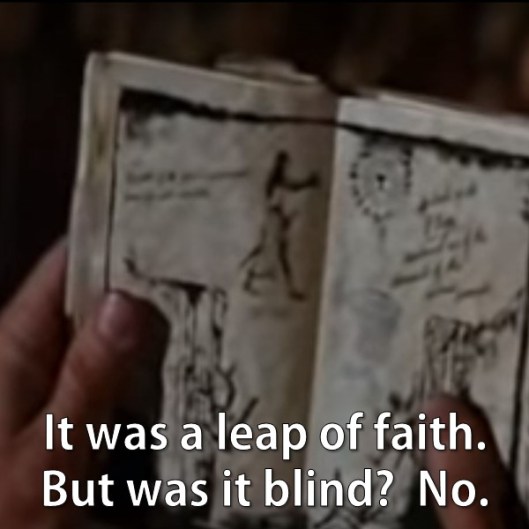
But don’t miss the facts.  Indiana did not simply come upon a cavern and blindly step into it.  He had his father’s lifetime obsession and meticulous study of the history of the grail.  He had his father’s notebook with a drawing of how he should approach the cavern.  And, he had the experience that the book was trustworthy – the penitent man doesn’t get his head chopped off, and the name of God is firm.

These EVIDENCES and EXPERIENCES and the person and character of his father are what Indiana Jones had faith in.  He trusted these things, and stepped out in faith.  The path was invisible, but his faith was not “blind”.  He had reasons to believe.

Evidential Faith in the Bible

Jesus encouraged this type of faith throughout the Gospels.  And he encouraged his disciples to put their faith “in Him” and in his miracles.

“Believe me when I say that I am in the Father and the Father is in me; or at least believe on the evidence of the works themselves.” (John 14:11)

“Later Jesus appeared to the Eleven as they were eating; he rebuked them for their lack of faith and their stubborn refusal to believe those who had seen him after he had risen.” (Mark 16:14)

(He didn’t rebuke them for their stubborn refusal to believe their own eyes that saw him crucified dead and placed in a grave.  He rebuked them for not believing what they should have accepted as reliable testimony.)

“A week later his disciples were in the house again, and Thomas was with them. Though the doors were locked, Jesus came and stood among them and said, “Peace be with you!”

Then he said to Thomas, “Put your finger here; see my hands. Reach out your hand and put it into my side. Stop doubting and believe.”

Thomas said to him, “My Lord and my God!”

Then Jesus told him, “Because you have seen me, you have believed; blessed are those who have not seen and yet have believed.” (John 20:26-29)

(Again, Jesus is confirming that those who have believed based upon the reliable testimony of the other disciples even to the present day will be blessed.)

This is not BLIND faith.  Blind faith in Jesus Christ would be believing “in him” without knowing the first thing about him, any testimony about him, nothing about your need for him, what his life, death, or resurrection meant, or even how he might be relevant to your life.  That would be strange faith indeed.

It is certainly NOT what Christians mean by faith in Christ.

:DW

No Blind Faith – Part 1

Central Thesis:

No one can actually believe in something blindly.

What is the concept meant by the term Christian “Faith”?

“Faith is believing what you know aint so.” – Mark Twain

“Faith is believing in spite of the evidence.” – Christopher Hitchens

“Believe me when I say that I am in the Father and the Father is in me; or at least believe on the evidence of the works themselves.” – Jesus of Nazareth

“Faith is being sure of what you hope for and certain of what you do not see.” – The writer of Hebrews (Chapter 11, verse 7)

We can dispense with the incorrect characterizations of Hitchens, Dawkins, Twain, et al completely by simply pointing out that their understanding of Christian faith is incorrect.  In fact, if they were accurately describing Christian faith as “believing in spite of the evidence”, then they would also be accurate in stating that Christianity is dangerous and tantamount to child abuse.  But they do not understand what the word “faith” means in a Christian and Biblical context.  Do you?

Blind_Faith_

This series of blog posts will explore what is (or at least should be) meant by Christians when they say they have “faith” in Christ.  This will serve dual purposes of causing the Christian to seriously consider HOW they themselves came to faith, and of providing a starting point for discussion with non-believers about the word “faith” in a Christian world view.

This series will explore the following:

  • Part 1 – Introduction to my “No Such Thing as Blind Faith” series of posts
  • Part 2 – What is the Biblical concept of the word “faith”?
  • How does one come to have “faith” in something?
    • Part 3 – Sources they trust – parents, pastors, professors, publications, papers, posts
    • Part 4 – Intuition – putting the pieces of life together (least “explainable” but still not “blind”)
    • Part 5 – Reaction to stress or joy – mountain tops and valleys in life
    • Part 6 – Experience – direct experience with Christ in some way
  • Part 7 – Conclusion, support of the central thesis, and how we come to change our minds

The bottom line

Many people shy away from apologetic study because the focus is on historical reliability, logical progression, reading, reading, and more reading.  They may incorrectly say, “I just believe” or even “I just have blind faith”, meaning (perhaps) that “I haven’t read all those books, but I have received comfort from Christ” (experience).  Or “I have seen Christ change my (child, father, mother, wife, husband, brother, sister), and can see that it is true” (sources). Or “I cannot explain how mankind (myself included) can be so evil without acknowledging sin, and Christ’s atonement lines up with this” (intuition). Or “I’m so wracked with grief; God help me!”  “I can’t contain my JOY! Praise God” (reaction). Or “God was there in my grief.  God was there in my joy!” (experience)  These are not as rigorously literary as a historical treatise on the evidence for the resurrection, but they are clearly not “blind“.  In one way or another, they are “evidence”.

There are separate posts on each of the above topics.  In the end, the central thesis “that there is no way to actually believe in something blindly” is strongly supported.

:DW

Morning Prayer

Tags

, ,

My previous post was focused upon the utility of listening to the music and prayers of the Daily Offices of Worship. It was a baby step – a distant and tiny LED light leading the depressed and grieving out of their darkness. The North Star is not the brightest star in the sky, but with that tiny light, one can navigate the Northern Hemisphere.

This post revels in the JOY of the Daily Offices of Worship. It is a testimony of the personal resonances of my heart. Let me illustrate what I mean by the resonances of my heart.

Sympathetic Resonance

Years ago, I discovered something amazing and beautiful. After tuning my trumpet to the piano, I held the sustain pedal down while playing an arpeggio C, E, G, C on my trumpet. The piano came to life with every string in the chord resonating with the sound from my trumpet.

Scientifically, the sound waves from my trumpet pushed on all the strings in the piano. The strings that were tuned to the notes in the chord began to sympathetically resonate (passively vibrate in phase) with the sounds coming from my horn. So the chord I played in series – one note at a time – became a full chord ringing all at once in the piano.

When I stopped playing my trumpet, the piano chord beautifully rang for several seconds. Amazingly, ALL the potential strings that could ring at multiples of the sound waves rang too. Thus, the piano chord rang at several octaves above and below what my trumpet played.

This became a favorite activity of mine. I would play various major and minor chords making the piano sound great or awful as the sympathetic resonances sang along with my trumpet.

This works best when the piano is in tune.

Spiritually, I suspect that this is one of the roles of the Holy Spirit of God in the life of the Christian.

I appeal to you therefore, brothers, by the mercies of God, to present your bodies as a living sacrifice, holy and acceptable to God, which is your spiritual worship. Do not be conformed to this world, but be transformed by the renewal of your mind, that by testing you may discern what is the will of God, what is good and acceptable and perfect. [Romans 12:1-2 ESV]

Let me insert the language I am trying to emphasize,

…present your bodies [to be tuned] as a living sacrifice, holy and acceptable to God, which is your spiritual worship. Do not be conformed to this world, but be [tuned] by the renewal of your mind, that by [tuning] you may [sympathetically resonate with] the will of God, what is good and acceptable and perfect.

I’m not doing deep exegesis, here. I’m merely using the concept of sympathetic resonance as an analogy to explain one way that God can fill and overwhelm our “hearts”, meaning our mental and emotional selves.

Now to the filling and overwhelming…

Morning Worship

The Venite – Psalm 95:1-7

I can remember singing these exact words in the Childrens’ Choir at Saint Andrew’s Episcopal Church in Fort Worth, TX. I was in 4th Grade. God has been tuning my heart with these words for over 40 years.

Oh come, let us sing to the LORD;
let us make a joyful noise to the rock of our salvation!
Let us come into his presence with thanksgiving;
let us make a joyful noise to him with songs of praise!
For the LORD is a great God, and a great King above all gods.
In his hand are the depths of the earth;
the heights of the mountains are his also.
The sea is his, for he made it, and his hands formed the dry land.
Oh come, let us worship and bow down;
let us kneel before the LORD, our Maker!
For he is our God, and we are the people of his pasture, and the sheep of his hand.
[Psalm 95:1-7 ESV]

Personal Reflection: Having a rock of salvation is extremely comforting. Psalm 62 speaks of God as a rock and a fortress – a place of supreme security. All the strong places are His, AND all the chaotic places like the sea are his, too. And we are protected as sheep are protected and cared for by their shepherd. Jesus said,

I am the good shepherd. The good shepherd lays down his life for the sheep. [John 10:11 ESV]

Benedictus

This is the Song of Zechariah. There are several “songs” in the Bible. They seem to be bold proclamations prompted by God’s spirit when significant events occurred. This sounds a lot like sympathetic resonance to me. God does something significant (this is the trumpet call) and his faithful sing out in resonance with his call (like the piano responding to the trumpet).

Blessed be the Lord, the God of Israel;
He has come to His people and redeemed them.
He has raised up a mighty Savior, born of the house of His servant David.
Through His holy prophets he promised of old that he would save us

  • From our enemies,
  • From the hands of all who hate us.

He promised to show mercy to our fathers and to remember His holy covenant.
This was the oath He swore to our father Abraham;
To set us

  • Free from the hands of our enemies,
  • Free to worship Him without fear,
  • holy and righteous in His sight all the days of our life.

[Now, Zechariah turns to his baby boy, John, and proclaims,]

You, my child, shall be called the prophet of the Most High,
For you will go before the Lord to prepare His way,
To give His people knowledge of salvation by the forgiveness of their sins
In the tender compassion of our God,
The dawn from on high shall break upon us

  • To shine on those who dwell in darkness and the shadow of death and
  • To guide our feet into the way of peace.

[Luke 1:68-79 ESV] Bulleted lists were utilized for emphasis and clarity.

Personal Reflection: Clearly, the language of fear and being set free were relevant in Roman-occupied Jerusalem. But this language is relevant at all times. We are self-censoring in this age of cultural Marxism because we are fearful of our “enemies”. This fear of disapproval can be seen as silly when our Christian brothers and sisters are being arrested, tortured, and killed by actual enemies using actual violence. But fear is fear. Enemies are enemies. And hope is hope. This Song of Zechariah proclaims real hope in the impending birth of Jesus. Zechariah’s son John alerts us to the darkness and the shadow of death that is on us all. John prepares us to see the dawn (Jesus) who shines on us and guides us into the way of peace.

Prayers

Collect for Grace

O Lord, our heavenly Father, almighty and everlasting God. You have safely brought us to the beginning of this day. Defend us in the same with Your mighty power and grant that this day we fall into no sin, neither run into any kind of danger, but that all our doings, being ordered by Your governance, may be righteous in Your sight; through Jesus Christ, your Son, our Lord, who lives and reigns with You and the Holy Spirit, one God, now and forever. Amen

Personal Reflection: Spontaneous prayer is good and we are encouraged by Paul to pray without ceasing. But these scripted prayers (called Collects) gather and summarize the prayers of God’s people, not just in aggregate on a given day, but also over time. This Collect for Grace was prayed over me essentially every Sunday of my life in Episcopal, Lutheran, and Methodist services. In all three denominational traditions, the same exact words were used meaning the prayer predates all of them. Amazing.

Thinking about the specific petitions in this prayer, I am comforted by the requests for protection. The phrase “ordered by Your governance” is one I have been recently chewing on. It could take a sovereign and fatalistic tone, which I struggle with. But it can also take a common grace tone, meaning that God in his grace to all mankind has established order in this world that is reliable. We are to seek His order rather than our chaotic sinful tendencies.

The Lord’s Prayer

Our Father who art in heaven;
Hallowed be thy name,
Thy kingdom come,
Thy will be done on earth as it is in heaven;
Give us this day our daily bread;
And forgive us our trespasses as we forgive those who trespass against us;
And lead us not into temptation,
But deliver us from evil.
For Thine is the kingdom and the power and the glory forever and ever. Amen.

Personal Reflection: Luther devotes a large portion of his Small Catechism to expounding on the Lord’s Prayer. I have little of substance to add to Dr. Luther’s exposition.

On a trivial note, I’d like to mention why I like the archaic language of the Lord’s Prayer. I don’t pray in King James English, but I am a fan of leaving the Lord’s prayer in this form for the following reasons:

  1. It is most widely known by English speakers in this form, and can be recited corporately at a moment’s notice in times of celebration and duress. This has been a powerful reminder of the 400 year Christian heritage of the English speaking world that persists to this day.
  2. It reminds people of the 400 year continuity of these exact words. Destroy the wording and you destroy the continuity, unity, and fellowship of language.
  3. It prevents the revisionists from monkeying. Allowing a modernization of the words “art, trespass, Thy, and Thine” might be fine, but this trip wire sets off an explosion of efforts to “modernize the meaning” of the various petitions. Many see the concept of trespasses and sins as archaic and in need of modernization.

(As an aside, how many Lutherans does it take to change a light bulb?
Answer: CHANGE‼?!???!???!?!     -Mea Culpa)

Benediction

The Lord Almighty bless us and direct our days and our deeds in His peace. Amen.

Personal Reflection: Again, one can read “direct our days and our deeds” in a controlling way or a gracious way. The director of a band does not control you. He does not force you to play your horn HIS way. He directs you to offer your music in an orderly way so that the whole family of musicians plays together, in tune, and in sympathetic resonance with His spirit.

Love to you all,

Darren

For more on my background, read what I believe and why and visit my About Page.

Passion for the Pain of Depression

Disclaimers

  1. I am not a counselor. I am a chemist. But I have also been to graduate school and lost a child, grandparents, aunts, uncles, and a dear brother-in-law. So my perspective includes the hell of intense pressure and the pain of intense loss.
  2. A discussion on depression is best held in dialog, but this is a blog. Comment streams and late night blog binging is no substitute for face-to-face conversation, comfort, and warm hugs. Consider this blog post a remote hug, but find a real hug from a real person, soon and often.hug
  3. This is not a ToDo List. In my opinion, giving a ToDo List to a person suffering from depression is futile. I do offer some things to explore, though.
  4. Lastly, my views on this topic offer a Christian perspective. I know of no other perspective that gives the hope that the Christian perspective offers. Please don’t run off if you are skeptical of the Christian truth claims. See if you think there is any wisdom in my perspective. Eat the meat and spit out the bones.

My Observations

Depression is not just “feeling sad”.

I remember in 10th grade health class, the teacher was discussing barbiturates, alcohol, and other drugs classified as depressants. I thought depressed meant sad, so I couldn’t imagine why you would take a drug that makes you sad?!?!

Obviously, I was wrong. The depressant part meant specifically that it depressed the central nervous system. Some are general like alcohol, and others are quite specific like some anti-anxiety drugs.

This is as far as I can go as a physical chemist. Pharmacology simply has too many variables for me to conceive or to model.

I’m reluctant to list the symptoms of depression because you may be like me. Seeing the list causes me to feel many of the symptoms. But if you must, here they are.

Instead of a list, here is a humorous story that illustrates the point. One of my students, several years ago, came to my office hours after missing class.

He said, “Dr. Williams, I have a problem.”
What is it?”, I asked.
My givashit is broke.”, he said.
Oh my! You have to get that fixed, immediately!”, I said as we both laughed.

We laugh, but we know that a broken givashit is not a laughing matter. It is sometimes a sign of depression or a panic coping mechanism. You simply cannot make a decision. And sometimes you don’t even care. You know this is a path that leads to destruction but you don’t give a ___ because your givashit is broken.

My Theoretical Musings

(My counseling colleagues are invited to correct or add to my musings in the comments section. Please contribute for the good of all!)

I have noticed that mental looping or stuck thoughts can break your ability to make a decision or to care about anything else. When I get stuck in an obsessive mental loop, I need something or someone to interrupt.

As a bona fide computer geek, I see the analogy of the operating system using interrupts to pause or to stop processes that are requesting CPU time. My Christian world view does not reduce the human brain to a CPU, but these analogies are still useful in my opinion.
You can’t get “into the machine” to stop a mental loop if you don’t have a reliable interrupt.

(Spoiler Alert: Music is a reliable interrupt system giving access to the parts of the mind that are “below” the looping executive and anxiety functions. Hence, music therapy.  )

How Do I…

  • Fix a broken givashit?
  • Stop obsessing about my obsessing about what I am obsessing about?
  • Break out of my negative mental loops?
  • Find a path out of this dull darkness of my soul?

This is a call to explore, not a self-help ToDo List.

A Passive, Intrusive, and Spiritual Path

The trail I’m hoping you will explore is passive, intrusive, and spiritual. You are able to “let it run”, passively receiving rather than actively giving. My suggestion is intrusive to interrupt the mental looping. It is spiritual because this is not a mechanical problem.

My suggestion is based upon my personal experience.

Daily Liturgical Worship

Daily liturgical worship is passive, intrusive, and spiritual.

Daily liturgical worship can be passive as the example below will illustrate. It can move to become more active over time, which is an amazing transformation. But start passively, one step at a time.

Daily liturgical worship is filled with simple melodies and singable tunes that echo in the mind all day allowing beneficial mental loops to interrupt negative and unwanted mental loops.

Daily liturgical worship is spiritual providing spoken and sung scripture with spoken and sung prayers that eventually become a part of your mental furniture.

Modern Christian practice (not just modern worship, but modern unscripted prayer, and modern “what does it mean to me” Bible study) has left us with no structure or form. It feels like there are no comforting chairs to sit in, no desks to study in, and perhaps no boundaries or walls to our spiritual imaginations. This is not freedom. This is lostness. These structures and pieces of furniture take time to build, but WE don’t have to build them. Jesus is the carpenter, and He uses his Word to build these holy places in our soul.

What IS Daily Liturgical Worship?

The early Christians continued the Jewish practice of reciting prayers and Scripture during certain hours of the day, which means this practice goes back over 2000 years.

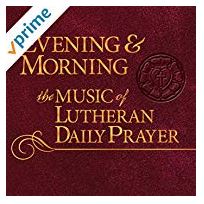
How can this be a passive practice? Well… with Amazon Prime, you can download the CPH Album Evening and Morning: The Music of Lutheran Daily Prayer.
CPH-daily-prayer

I have listened to Morning Prayer, Evening Prayer, and Compline on my phone nearly every day since June 2018. I have interspersed Matins, Vespers, and the Litany on special occasions or when I felt like it.

Are you worried by the word Lutheran?  Don’t be. These readings, Scripture, and tunes go back to pre-Lutheran, pre-Eastern Orthodox, and even pre-Roman times. The Lutheran part of this is the compilation of these ancient services into the Lutheran Service Book published by CPH.

You can listen to these services passively when commuting, when anxiety strikes, when you want to pray but don’t know how or what to pray, when waking, when lying in bed before sleep, when you are praying for sleep to come, and when you are seeking the will to get out of bed.

Not now, but down the road as your motivation returns, this worship can transform over time from passive to active practice. Get a copy of the LSB from CPH and follow along when motivation strikes. But don’t force it at first. Just listen to the love and encouragement that Morning, Evening, and Compline Worship brings.

An unexpected benefit to your personal private consumption of this eternal beauty will be when you run across a congregation that is using elements of these worship services. Your soul will soar as you hear and participate with others in these ancient readings and songs. I’m sure you will be amazed when you find patches of this fabric of worship in Lutheran, Episcopal, Methodist, Presbyterian, Roman Catholic, and even Eastern Orthodox services. It always catches me by surprise when I visit a friend’s church and find some ancient tune, song, chant, prayer, or reading that is common among our different traditions.

The interrupts are effective. The simple melodies of these selections of daily liturgical worship are from a bygone era. Some are quite ancient. All of them are capable of comforting you throughout the busy day. I find my mind humming them often during mental downtimes at work. Their haunting tunes are comforting to me. Their ancient origin connects me to the past and the text gives me hope for the future.

This is most important:
Daily Liturgical Worship is Spiritual.

Jesus, the carpenter of our souls tells us,

“God is Spirit and those who worship Him must worship in Spirit and in truth.” (John 4:24)

And Jesus prays to the Father on our behalf, asking Him to

“Sanctify them by the truth; your word is truth.” (John 17:17)

These rituals of daily worship are almost 100% Scripture – using truth to worship Truth. They contain the spirit-filled proclamations of Mary (Luke 1:46-55), Zechariah (Luke 1:68-79), and Simeon (Luke 2:29-32) and many ancient prayers of the church.

The Whole Point

The whole point of this blog post is captured at the end of the Song of Zechariah:

“In the tender compassion of our God,
The dawn from on high shall break upon us;
To shine on those who dwell in darkness and the shadow of death;
And to guide our feet into the way of peace.”

Meditate on that. Are you in darkness? Are you in the shadow of death?
I know you are because we ALL are. We ALL need Jesus to guide our feet into the way of peace.

I pray that the daily practice of worship and prayer will help Jesus guide your feet as it helps Him guide my feet. These wonderful, beautiful, and healing words bathe my soul daily.

Closing Analogy

Does this get old? Does the novelty wear off? Of course it does. How could novelty not wear off? What did you expect?

This practice is more like bathing than swimming. Swimming is recreational and novel. Bathing is often mundane and necessary, but it is also refreshing and life-giving.

catbath

We (many of us) bathe daily. Why not worship daily?

Let us invite the passion of the living and active Word (Heb 4:12) to renew our minds, daily. Hear what Paul says:

“Do not be conformed to this age, but be transformed by the renewing of your mind” [Romans 12:2a CSB]

Hear what Jesus says:

Come to me, all who labor and are heavy laden, and I will give you rest. Take my yoke upon you, and learn from me, for I am gentle and lowly in heart, and you will find rest for your souls. For my yoke is easy, and my burden is light.” [Matthew 11:28-30 ESV]

Hear what Paul says, again:

For I am sure that neither death nor life, nor angels nor rulers, nor things present nor things to come, nor powers, nor height nor depth, nor anything else in all creation, will be able to separate us from the love of God in Christ Jesus our Lord (Romans 8:38-39).

We pray.

Be present, merciful God, and protect us through the hours of this night, so that we who are wearied by the changes and chances of life may find our rest in You; through Jesus Christ, our Lord. Amen. [from Compline]

Love to you all!

Darren

Check out my musings on Morning Prayer, next.

For more on my background, read what I believe and why and visit my About Page.

The Gosnell movie opens today in 750 theaters, and I’m going to see it!

I read the book. If you see this movie, please think about the criminal negligence of the pro-abortion officials who didn’t want to know what was happening in Gosnell’s clinic. The health department did not inpsect his clinic for 17 years (as per my memory of the book). THEY should be on trial too, but that would be called a witch hunt or a politically motivated prosecution. But it is not about politics. I hope those in Philly who turned a blind eye to Gosnell are confronted in their hearts by their sins of omission. And that they fall to their knees to ask God for forgiveness. His courtroom will not be avoided, by them or by us. Lord have mercy on us all.

Wintery Knight's avatarWINTERY KNIGHT

These empty benches at the Gosnell trial were for the mainstream news media Empty benches at the Gosnell trial reserved for the mainstream news media

Since I’m going to see the Gosnell movie today, I thought I would read a few articles to remind me of the facts. The best article was by the film makers themselves, writing for the Daily Signal.

They say:

In progressive Pennsylvania, here was a doctor, Kermit Gosnell, an African-American, he’s in his early 70s now, who ran an abortion clinic for 30 years, where he routinely, and these are not my words, this is the grand jury’s words, where he routinely delivered babies alive and then cut their necks with scissors.

And he did this for 30 years. That’s why in the eyes of the grand jury and also ABC’s Terry Moran, he was described as America’s biggest serial killer, which is the phrase we use in the film.

There’s so many details that are worth…

View original post 482 more words

#WalkAway and Search for TRUTH

Tags

Being a professor means I analyze the world around me, I find thoughts and theories that align with reality, and then I profess these ideas to others to pass on the torch of knowledge.

Chemistry has been the area of reality that I have studied the most. Therefore, chemistry is the topic about which I profess the most often and in the most detail.

Christianity’s description of reality is the second-most active area of my study. I emphasize the word STUDY. I thrive on QUESTIONS.

Why God? Who’s Jesus? Why would someone think the Bible is believable? And on and on.

Lately, as I work with a student group that makes the case for the truth of Christianity, I have been studying one of the most important topics we can study.

How does someone CHANGE their mind?

In my studies of this I have been fascinated by atheists who have converted to Christianity. And, I have also been fascinated by Christians who converted to atheism.

This is why I have been lit up by the #WalkAway video movement.

thumbnail

It has only been 3 months, and there are over 100 personal videos posted on their official YouTube channel describing their #WalkAway moment where they decided to walk away from the Democrat Party or “The Left”.

I put the playlist on Play All and have been amazed at the moments when the mental switches flipped.

Here are some things I have noticed.

  1. Congratulations to anyone who has had a #WalkAway moment. You now have experienced what it is like to listen to a different channel than the default channel you grew up with.
  2. Noticing NEW FACTS is NOT voluntary. You can’t MAKE yourself believe something new or force yourself to believe something old once NEW FACTS have been truly noticed.
  3. Something about the new facts matched the world you ACTUALLY live in. You assented or ACCEPTED that these new facts are TRUE.
    1. This acceptance of new facts matching reality relieves a tremendous amount of cognitive dissonance (mental discomfort), and so an emotional rush comes from this assent. This is in nearly every #WalkAway video.
  4. Lastly, when you realize that you have accepted new facts that to the best of your understanding match REALITY, you are faced with “crossing the line” – taking action.
    1. This requires a ton of TRUST that the facts you have collected and accepted as matching reality are TRUE. Taking action on wrong facts will have negative consequences.

These three steps are present in every #WalkAway story that I have watched: 1) noticing new facts, 2) assent to their truthfulness, and 3) trusting in their truthfulness by taking ACTION.

I’ve also seen these same steps in every conversion and deconversion story.

Surprisingly, these same steps were identified 500 years ago (and probably originated earlier) using the latin words noticia, assensus, and fiducia. (Apology of the Augsberg Confession, Philip Melanchthon, 1530)

But NOW WHAT?

So you have now had a #WalkAway moment from the Left or Democrats or whoever. Great.

Here are my recommendations going forward.

  1. Noticia: Keep “noticing new facts”. Don’t let that nerve go dormant ever again.
    1. It is my view that this “waking up” to notice new facts is a soulish or spiritual activity.
    2. Noticing facts about your own failings and brokenness is actually the work of God. Jesus said this would happen in John 16 “he will convict the world concerning sin and righteousness and judgment [John 16:8 ESV]” YOU don’t wake yourself up to this fact, it is an act of God in your life. Jesus calls it “conviction”. Yes, it is uncomfortable.
  2. Assensus: When you see that these facts line up with reality, you have a choice – resistance or assent.
    1. Forcing yourself to ignore facts you believe to be true is a horrible way to live.
    2. Do your research. If you have political questions, read more about politics. (Don’t take an actor’s or newscaster’s word on politics. Duh!)
    3. If you have religious questions ASK an intellectual RELIGIOUS person. (Don’t take an actor’s or newscaster’s word on spiritual matters, especially if their only opinion is mockery. Duh!)
    4. THE BEST PLACE for you to explore the facts related to Christianity is at a Ratio Christi Chapter on a college campus near you, or at a Reasonable Faith chapter, or at a Reasons to Believe chapter, or their websites and the Stand to Reason website.
  3. Fiducia: You will know when it is time to take action. There’s always a line to cross.
    1. For #WalkAway, it was making a video.
    2. For Christianity, it is taking action by trusting that God is there through prayer, or going to a church, or being baptized as a Christian.
      These actions make no sense if noticia and assensus are absent. So don’t stress about it at this time.
      (A note about choosing a church, if the leaders of the church do not value apologetics then move on. Apologetics is ‘making a case’ for the truth of something. A church that doesn’t engage in ‘making a case’ for their view is full of synchophants who will be suspicious of anyone asking questions. Move on.)

My message to the #WalkAway movement

You are enthusiastic about searching for the TRUTH. I don’t want you to lose that spark!

Seek the truth! Always.

Jesus said, “I am the way, the truth, and the life.”

IF he was right, then a search for truth will lead you to Him.

If he was not right, then it wont. You have nothing to lose by searching.

It’s great to #WalkAway, but where are you going to WalkTo?

I love you all. If I didn’t, I wouldn’t have this page.

Darren

6 Straight A Christian Thinkers

I’m reblogging so that more people will find this post. AND reblogging so that I can find this post again in the future. It is a nice summary of our A-Team. -Darren

Kenneth's avatarReflections

shutterstock_311153759-1024x698

The Christian church has been graced with brilliant and influential thinkers since its inception. A list of “who’s who” in Christian scholarship would be long and diverse in terms of scholarly disciplines. To whet your appetite in the areas of theology and philosophy, here’s a snapshot of six “straight A” thinkers.

By “straight A,” I mean two things. First, I’m noting that these thinkers were all brilliant scholars (no doubt, they would’ve received straight A report cards in today’s grading system) and accomplished philosophers and theologians who advanced Western civilization in general, and Christianity in particular. Second, all of these distinguished Christian scholars’ names begin with the letter “A.” So they’re Christendom’s A-Team!

Christendom’s A-Team

Here’s a brief summary of the “straight A” Christian theologians and philosophers from ancient and medieval Christendom and what they are known for:

  1. Athanasius (ca. 296–373), Defender of Orthodoxy

Athanasius is one of the most honored theologians in…

View original post 523 more words

Amazon Prime and Liturgical Worship

You would be hard-pressed to estimate my excitement when I saw the following album in my Amazon Prime Music App.
CPH-daily-prayer

This is an excellent recording of the Daily Offices – prayer services that fill the day with worship and praise. First, let’s define some terms using the Liturgical Glossary of the LCMS…

Daily Office
Services of prayer offered at established times each day. Already at the time of Jesus, set times for prayer were customary (Acts 3:1). By the sixth century, eight services of prayer, which included psalms and readings from Scripture, were observed in the monasteries. Since the Reformation, this schedule has been simplified to three times of prayer: Morning (Matins), afternoon/evening (Vespers), and close of the day (Compline).

Liturgy
In the Lutheran Confessions, liturgy is defined as “public service” in the sense that the proclamation of the Gospel and administration of the sacraments is God’s service done on behalf of his people. Sometimes the word is used to denote an order of service, though the more specific terms “order of service” or “ordo” are preferred.

MatinsThe first of eight daily prayer services that developed during the Middle Ages for use in the monasteries. At the time of the Reformation, these services were reduced to two: Matins in the morning and Vespers in the evening. Matins is a Middle English word that comes from Latin for “of the morning.”

Vespers
A Latin word meaning “evening.” Originally one of eight daily offices prayed during the Middle Ages, Vespers was retained at the time of the Reformation as one of two daily services, the other being Matins. Sometimes also referred to as Evening Prayer.

Compline (KAHM-plin)
Similar in nature to bedtime prayers, Compline is the last of the daily prayer offices that came into use during the Middle Ages. Prayed in later evening, the service is simple in nature and includes this appropriate antiphon for use with the Nunc Dimittis: “Guide us waking, O Lord, and guard us sleeping, that awake we may watch with Christ and asleep we may rest in peace.”

Litany
In general, a responsory prayer with repeated congregational responses. In the Divine Service, the Kyrie is sometimes cast in the form of a litany, with the congregation responding to each petition with the words, “Lord, have mercy.” An expanded form of this litany is found in Evening Prayer. The most comprehensive form of the litany is the medieval version that was revised by Luther and still appears in hymnals today.

Chanting
A method of singing liturgical texts that are not metered (as in a hymn). Most chant consists of short phrases that are sung responsively between pastor and people. Psalms may also be chanted as well as parts of the liturgy (e.g., the Gloria in excelsis, The Lutheran Hymnal, p. 17).

The Lutheran Service Book (and the CPH Album) also includes Morning Prayer and Evening Prayer. Both are presumably included as alternatives to Matins and Vespers, respectively.

Now, the question you are probably asking, “Why would DW be so excited about this?”

There are several contributing factors:

  1. I was raised in a church that utilized a fair amount of chanted liturgy, especially the Venite. I have experienced even more chanted liturgy since joining the Lutheran Church in 1992.
  2. The popularity of chanted liturgy is waning, and I miss it dearly.
  3. I read the Benedict Option by Rod Dreher this summer where a bold apologetic for the disciplines of worship was made.
  4. And finally, I experienced two breath-taking chanted worship services at the Texas District Convention of the LCMS last June. This is explains my excitement when I found the CPH Album shortly after that convention.
  5. I felt a great need for more structure for my devotional life.

Therefore, I began in late June to listen to Morning Prayer in the morning during breakfast, pausing to read the Bible on my BlueLetter Bible App (My #1 recommended Bible App).

In the summer, I often drive home for lunch to get some extra family time. So I would listen to Matins on the way home. I would listen to Vespers on the way back to work. I’d listen to Evening Prayer on the way home from work at the end of the day. And saving the best for last, I would listen to Compline with my head on the pillow at the very end of the day.

Did I do this EVERY day? No.

Did I get at least 2 in every day for two (going on three) months? Yes.

So what? Glad you asked…

Dispelling Myths

I am 100% Lutheran when it comes to the view of participation in works. Listening to these services, singing along with all my heart and with a full voice, and praying the prayers did nothing to aid my salvation. There is no works-based or participatory merit system in play.

So what do I “get” from it?

I experienced all the following thoughts and feelings at various times. I am sure these are common to many people when they encounter chanted liturgical worship. I’ll outline them very briefly.

Curiosity

I was curious about the various prayers and canticles. I was pleased to recognize many of them as hymns of praise directly from Scripture like the Magnificat, the Nunc Dimittis, the Benedictus, and the Venite.

Magnificat (mahg-NIF-ih-kaht)
The opening word in the Latin text of the song of Mary from Luke 1:46—55, “My soul magnifies the Lord.” This New Testament canticle has been sung at the daily service of Vespers (Evening Prayer) for some 1,500 years.

Nunc Dimittis (noonk di-MIT-iss)
Latin for “now dismiss.” These are the words spoken by Simeon as he held the 40-day-old Jesus in his arms (Luke 2:25—35). One of the New Testament canticles, it was traditionally used in the daily service of Compline and as an alternate to the Magnificat in Vespers. In the Lutheran Church it is also appointed for use following the distribution of the Lord’s Supper.

Venite
Latin for “oh, come.” The title for the song of praise taken from Psalm 95 that is sung at the beginning of Matins/Morning Prayer. The first line reads, “Oh, come, let us sing to the Lord.”  (Above, from the Liturgical Glossary)

The Benedictus
(also Song of Zechariah or Canticle of Zachary), given in Gospel of Luke 1:68-79, is one of the three canticles in the opening chapters of this Gospel, the other two being the “Magnificat” and the “Nunc dimittis”.

Nostalgia

As mentioned my earliest childhood memories of church were of singing the Venite in particular. The tune in Matins is exactly the same as the one I sung as a small boy in the Episcopal Church in the early 70’s.

Connection to the Past

I feel a deep connection to the body of Christ – his church – singing words and tunes that predate all the schisms that have occurred throughout the centuries. Ancient vs Modern, East vs West, Protestant vs Catholic – we disagree on creeds, councils, and popes, but we still sing the Magnificat and other canticles to tunes that have been in use for well over 1000 years. Amazing.

Novelty

Some of the song tunes were familiar, but many were not. It was very enjoyable to learn them over time. If singing along, I would mess many of them up. But I knew that over time I would get better. Taking a long view helped. It is a new and interesting exercise – practicing the liturgy, daily. In fact, that is what a DISCIPLINE is. It is “an activity or experience that provides mental or physical training.”

[1Co 9:26-27 CSB] 26 So I do not run like one who runs aimlessly or box like one beating the air. 27 Instead, I discipline my body and bring it under strict control, so that after preaching to others, I myself will not be disqualified.

Negative Emotions or Responses

It is important to point out the cons as well as the pros.

Pride

Pride is always a risk. It is also one of the most difficult emotions to guard against. Even the acknowledgement that it is a risk can lead to pride in one’s own self-awareness. This is a bottomless pit. Therefore, it is best not to “selfie” the Daily Offices. Focus on worshiping God, not on the act of worshiping God. And PRAY for mercy. The Holy Spirit can accurately diagnose and alert one’s heart to the rise of pride.

[Jhn 16:7-8 CSB] 7 “Nevertheless, I am telling you the truth. It is for your benefit that I go away, because if I don’t go away the Counselor will not come to you. If I go, I will send him to you. 8 “When he comes, he will convict the world about sin, righteousness, and judgment:

Boredom

Do the same thing long enough and the mind, especially the smart-phone-induced-short-attention-span mind, becomes bored. I know the words and tunes by now.

The well-known risk of rote behavior is real. So what is the remedy? Here are a few that I have experienced this summer.

  1. Check my motives. Why am I singing these songs of praise? Am I doing them to merely learn them? If so, then job done. But, if I am actually praising God, then they are merely a vehicle for my praise. This adds weight back to the practice.
  2. Move beyond the self-satisfaction of knowing the words and tunes. Now that I know them, I can meditate on them as I sing them. They become a deeper part of my thinking. THIS has allowed the words of praise to become MY OWN.

Don’t miss this. It took time and practice for these hymns of praise and tunes to penetrate my mind to a level that they became a part of me and how I worship God.

This fact alone is what bothers my conscience with the cut-and-paste bulletin liturgies of the modern church. I cannot deeply mean a prayer to my God that I have just been handed in a church bulletin. I need to chew on these prayers for months, years, and maybe decades before they become an inseparable part of my soul and my soul’s song to God. My favorite prayer is in the service of Compline.

Abide with us Lord, for it is toward evening, and the day is far spent. Abide with us and with Your whole Church. Abide with us at the end of the day, at the end of our life, and the end of the world. Abide with us with Your grace and goodness, with Your holy Word and Sacrament, with Your strength and blessing. Abide with us when the night of affliction and temptation comes upon us, the night of fear and despair, the night when death draws near. Abide with us and with all the faithful, now and forever. Amen.

It will take time for me to memorize this prayer, and I look forward to the task over time.

In fact, Luther in the preface to the Small Catechism entreats pastors and teachers to

…above all be careful to avoid many kinds of or various texts and forms of the Ten Commandments, the Lord’s Prayer, the Creed, the Sacraments, etc., but choose one form to which he adheres, and which he inculcates all the time, year after year. …

Is boredom a risk? Always. Are there fertile valleys on the other side if we would check our motives and cultivate a meditative attitude on what we are saying and singing? Yes.

Ending on a Positive Note

Unexpected Blessings

As I approach the car to head home, I now face a temptation to “move on”. I’ve experimented with the Daily Offices. It was enriching, but I’d really like to listen to another Issues Etc podcast.

Is this boredom? A quest for novelty elsewhere? Both? Not sure. I have skipped a few times to keep from being legalistic about these things. (Nice self-justification, there.)

Other days, I stayed the course and listened/sang through the service.

I have noticed repeatedly, that these tunes stick in your head for several hours and often days. I have also noticed repeatedly, that having words of praise rattling around in your head all day is a GOOD thing. These unexpected blessings are magnificent.

One of the first Bible memory verses I ever learned as a child was Psalm 119:11 “Thy word I have hid in my heart, that I might not sin against Thee.” I have thought all my life that memorizing a Bible verse was the same as hiding it in my heart. And to an extent I still think that is true.

I have come to see that these songs of praise have gone deeper into my mind, soul, and heart than any short or long-term mnemonically-memorized verse can ever hope to go.

These songs of praise and prayer are singing through my mind as I go about my work, When temptations arise there is a major mental showdown. It is very difficult to block out the beauty of the chanted daily offices so I can indulge in a petty yet dangerous diversion. Thy Word has been planted deep in my heart.

Sometimes it is tempting in the evening to just crash without a bath, but it is always better in my opinion to wash the day away. So now, when I approach the car and think, “am I going to listen to Matins on the way home?” I see it as taking a mental bath, and it serves its intended purpose by renewing my mind.

[Rom 12:1-2 CSB] 1 Therefore, brothers and sisters, in view of the mercies of God, I urge you to present your bodies as a living sacrifice, holy and pleasing to God; this is your true worship. 2 Do not be conformed to this age, but be transformed by the renewing of your mind, so that you may discern what is the good, pleasing, and perfect will of God.

My participation in the Daily Offices has been a powerful experience in many ways. They are straight from the Scripture and appear to be renewing my mind. My hope is that they, with regular study of the Scripture, will fulfill Jesus prayer for me (and for you) in John 17.

[Jhn 17:17 CSB] 17 “Sanctify them by the truth; your word is truth.”

In Closing, I’d like to point out that since I have downloaded this album to my phone I have played snippets of it to three other people. All three lit up and wanted more.

It has been like dropping a spark onto dry grass.

I didn’t expect that at all. I thought I was a little off in my love for the ancient tunes and songs of the Daily Offices. Maybe I’m not.

Love to all,

Darren